company - education - coffee
Showing posts with label fresh coffee. Show all posts

Tuesday, February 05, 2013

What local can do


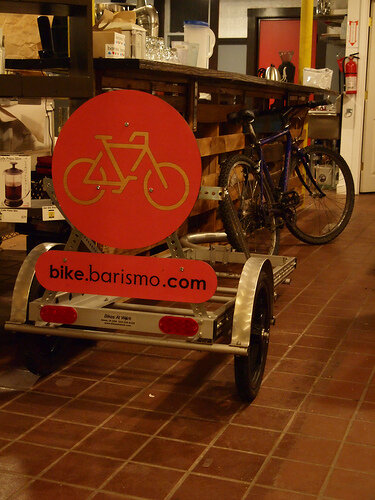
Follow this bike to good coffee
You'll see our new and improved bicycle cart touring greater Cambridge loaded up with coffees for locals.  Fresh coffee delivered within hours of roasting has been a fun thing to be a part of.  It just made sense to launch this given how bike friendly Cambridge and Somerville are.  After seeing how supportive the feedback has been as shop owners and more customers take notice of the bike in town, we are glad we did it.

Track it through bike.barismo.com where we are testing out using a foursquare script to locate where the freshest retail shows up.  We are also updating our stops on twitter so that you can get yourself over there for some bags.

Relationship coffee delivered the same day it's roasted or the next morning is kind of a cool thing.  Since fresh roast is such a key component to great coffee, we consider this a bit of a quality assurance project!

We're having fun with it and hope you can support this project by picking up a bag of coffee at one of our stops.

Saturday, November 26, 2011

Why we don't pre grind coffee

The basic tenets of good coffee are the 4 F's:
Fresh crop
Fresh roast
Fresh grind
Fresh brew
As a quality focused roaster, we strive to adhere to these core ideals as they are the fundamental building blocks to a great coffee experience.  Some of these items are much less complicated than you may think.  Fresh crop can be either a date off harvest or it can be about packaging the the unroasted coffee better than the traditional jute bags of old.  Protecting the coffee in Grainpro or vacuum sealing it in some cases can preserve the life of a coffee substantially.  Packaging can protect the coffee from cross contamination, prevent rapid aging, humidity contamination, and many other issues that may affect flavor.  What temperature unroasted coffees are stored at can also play a role in how a coffee ages and how fresh it is.  A warehouse in the summer heat and humidity of the deep south will fare much worse than a temperature controlled (cool) and dry storage site.

We take pride in fresh roast being the only area roaster to place our roast dates so prominently on the front of every bag.  We feel like the roast date is a badge of quality.  Where other roasters may hide their roast dates or place arbitrary best by dates months out to make inventory easier to sell, we know many coffee connoisseurs value knowing when it was roasted and we aim to serve them.

Fresh ground is the one where we often get into a tricky situation.  We are the only roaster in the area that sells wholesale but doesn't ship preground coffee to accounts or retail consumers.  For many reasons beyond the obvious staling of preground coffee, we made it a policy not to grind.  We do lose some wholesale clients on this, namely many restaurants, but feel it's essential.  We feel it can be a serious disconnect to expect a wholesale/retail customer to pay for premium coffees and then brew/serve a less than premium cup.   We also have a policy in store not to grind bags for customers (and don't have a bulk grinder for this) based on the same idea.  Fresh is better, but paying $18/12oz bag of preground coffee that obviously won't taste like an $18/12oz bag of coffee should if ground fresh probably isn't a good value.

Fresh brewed is the easy one that everyone gets.  Brewing fresh is the final aspect full of caveats and variant methods.   We like to offer and suggest per cup or on demand brewing as much as possible because it makes a difference.   The coffee always just tastes better when brewed in smaller and fresher batches, what's smaller and fresher than a cup at a time?  We have many brew guides on the blog and even some helpful bits of barista info in shop you can pick up when you drop by, so don't hesitate to ask. 

We might also be the only roaster in the area with an all per cup bar as well but the biggest contrast is definitely the preground issue.  The reasons laid out are why it isn't an option on our online site nor in store, we hope you understand and look forward to your continued support.

Friday, October 17, 2008

Jute free since 07

I know 'in season' is marketed as a cutting edge deal or at least that's the pitch. In an industry full of so much gimmicky nonsense and blatant chicanery, it is a good start. The thing that I want to know is what about the handful out there who aren't going the jute route? Where do we fit in this whole in season model?

There are two roasters local to our area who are adamant about not storing coffees in jute. We are very happy to to be one of them so excuse our barismo bias. Are there any others in North America whose entire storage is vacuum packaged?

If you want in season, you have to keep the coffee as close to the farm gate as possible and the concept that freshness is only a byproduct of time is a bit of a generalization. Time is only one of several factors that affects freshness. Setting a sell by date on milk would be silly if it were not stored in a proper container, away from contamination, and then kept at stable appropriate temperatures.

Why do we assume green coffee is so immune to age that it can sit in jute bags for months in open warehouses and say that the coffee will be fine? How can we even begin to account for the conditions of storage the coffees endured in transit? The fluctuating humidity and wildly changing temperatures are as fickle as ... well, the weather.

If we are going to trademark every term about quality, let's start with accounting for how the coffee get's here. Was it really fresh and in season when it arrives 3-4 months off milling and wasn't protected in some degree from the factors that act as catalysts for degradation?

This week provided an affirmation of just how difficult this issue is. I had to rejigger my whole roasting profiles as the new vacuum packaged at origin coffees began arriving. The Kenya Kiandu was our most recent lesson in how freshness makes a huge difference. After moving through an excellent batch, we began working through a bag that had lost it's seal at some point during transport. It was not the same coffee. The sweetness was there but the roundness and freshness of the coffee was no longer there. It just wasn't as dynamic and was a bit on the tannin side of the equation. That's still better than the wood and paper notes you see as a coffee really turns the corner and you have to move darker to balance the coffee.

I am profiling the Guatemalan coffees that have just arrived which were vacuum sealed at origin like the Kiandu and I will honestly say, I intend to work to have every coffee we source jute free from this point on, before it's arrival. It isn't cheap but fresh coffee doesn't begin and end at the roast date on the bag, it starts way back at the mill as that coffee leaves parchment and begins the long journey here.