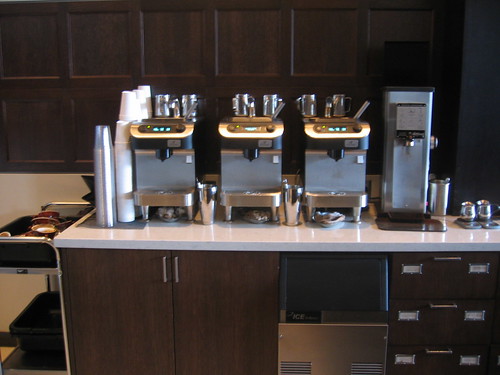
Problem is, I was never on the bandwagon with the hipsters who fell hard for the Clover brewer. I know it's unfairly hip now to be anti clover and tote the 'back to manual' bit even when few are willing to spend the time to learn what that really means. Sadly, that's how the online community works. So many people are trying to reinvent the wheel with approaches to pour over and syphon when you really just need to start with a good base. If it was easy, everyone could do it amazingly well and yet we have a generation of barista who came into coffee focused on espresso and latte art that are just in the last year finding these old brewing methods again. The book is still open on that one.
Clover always had a few problems with it's design that kept me from getting behind it. So let's go.
Top 5 reasons you shouldn't feel bad you didn't get a Clover:
#1 Fines. The metal filtration really just didn't do it. Clean cup? Out of the question. You could go with a finer screen but the simple fact was that you cannot equate the depth filtration of a cloth filter or the cleanliness of a paper filter in any metal filtration. If you want a very expensive french press brewer where you end up using a coarse grind and enjoy the sediment, you missed out when Clover was available.
#2 Temperature. On several machines we tested, the actual temperature seemed to have different drifts. It could have been issues with different versions but we noticed very quickly there was a temperature drop in the brewing chamber on the machines we had access to. This one never really made sense when you had a heat wrap that was essentially limited in how high it could be set which would have cured the temperature drop problem. It's hard to argue that anything other than flat line brew temperatures in espresso or any other method is a good thing yet nobody voiced this concern in public.
#3 Extraction. Because of the declining temperature and the fines issue, you simply had an under extraction problem. Shooting for short brew times and volume duty in this design meant sacrificing a full extraction. You could compensate by upping the dose but often the cups were either paper thin with a light dose or all high end and fleeting with a hefty dose. Some rationalized this as a 'Clover Cup' vs a paper filter but it was a widely known issue.
#4 Agitation. The trick to squeezing a little more sweetness always seemed to be contentious. Our version which was not widely practiced is as follows: Make sure the water is up to temp and the chamber is full. Then add the coffee and stir it to get a full immersion. Another optional stir mid brew and then a final stir just as it draws down. Just like a Syphon which allowed our brew times on Clover to be longer than others who used the stock whisk and recommended method. While that could do something towards getting a little fuller sweetness, the other problems of filtration were often made worse by agitation that caused fines to filter to the bottom or center. Anyone who has spent time time with technical Syphon methodology (not the steaming scalding ones of tradition) and pour over begins to see this relationship is very important relative to draw downs and the extraction of bitter and astringent flavors.
#5 Clovernet. Did any of the indy shops who bought a Clover ever have a need for this?
Of course, I now wear my Clover shirt proudly and bring the mug out for special visitors. I like it particularly because the hipsters want to ditch the Clover so badly and knock on it's sale to Starbucks yet when they bought it, it was the best thing ever. Clover is not any better or worse than it was before it was bought but the truth is that like many things in our community, the signal to noise ratio is often pretty poor.
Frankly for the perfect fit, you would need a fairly dark roasted coffee for which you could under extract the roast bitters and then the heavy up dose might squeeze some origin character out of otherwise very stale coffee. Then you just need a customer base that would interpret sediment as body. The coup de grâce would be hundreds or possibly thousands of shops that would need to be coordinated by a simple electronic or possibly online interface that superseded dependence on it's end user for calibration(aka Clovernet).

Tuesday, August 26, 2008
Clover coffee brewer

Monday, March 31, 2008
To the next 'golden' brew

Right now, there is a lot of navel gazing going on in the blogs about what brew methods are best, what to do now that the clamour for Clover turned into the planet buster on the death star....
A lot of people are talking about moving to the manual methods or anything new that's less automated. Siphon, pourover bars, and getting back to basics are becoming the buzz words. I think it's just a movement in trying to find a new niche, the new amazing brewer that will give them the angle. Specializing and definite product differentiation from the big boys. I am proud there are some serious cats out there brewing vac with all the tedium and technical precision of a guitarist mid solo but they are the few among a mob of new found fans of the manual method.
The times are changing and nothing is settled right now. There are no firm standards and we have no clear direction where things will be in the next year. It was not too long ago that I believe we were in the dark ages of coffee on the verge of change. Sure the forums were buzzing and 3wavers were aplenty working for 'the goal', but it was a time with a lot of passion and very little substance. Vac sealing was something only eccentrics did and few would publicly admit how much coffees deteriorate much less think about freezing a coffee.
The focus was on the equipment mods, ritual movements in preparation, and all about these name brand 'black box' blends. The forums were left to the machinations of latte artists proclaiming the value of triple rosettas and pacman blowing flames in your cup AND gratuitous photo series of 'naked' portafilter triple thick one ounce muddy baked 'chocolate' shots. Sure, there was an interesting segment focused on how to hack some cheapy piece of equipment into some better cheapy piece of equipment.... but eventually, you PID your PID and it becomes redundant so you end up buying the best equipment after spending lots of cash on a series of small modded upgrades.
Somewhere along the way, a lot of focus on the actual coffees was lost. Sure, I realize everyone is 'about letting the coffee speak for itself' and other catchy phrases but a little less time on forums talking about the concept and more time living it would help us all.
It's all the more complicated these days by marketing that is geared at direct trade and relationships where the farmer as a brand is glorified on one hand and on the other often then repackaged in mill marks where the farmer disappears again. Transparency is a funny thing we all talk about but don't really ever see or have the access to understand.
Then there are coffees where the placement in contests or prices paid set notoriety and it can simply be a contest to pay the highest price for the right to pay the highest price AND then you have press and buzz based on expensive brewing equipment and 20K utterly superfluous heating elements clouding the picture of what is really good coffee and what is just an expensive lamp making cheap coffee at a high price.
So, if you can clear through the fair trade, organic trade, direct trade, bidding wars, ego trips, pricey brewers, complicated techniques, barista flair, and well, everything but cup taste to well... simply cup taste, that's an amazing moment of clarity.
Things haven't really changed that much but I am thoroughly excited by splintering segments of the industry headed in new directions. The point is, there are great things going on in coffee BUT you have to dig deep and often the people doing the most amazing bits don't spend time cruising coffeed or CG, they are out there doing it. Marketing rarely cuts through to the tiny elements that can help make or break a good coffee.
Tuesday, March 06, 2007
AeroPress Revisited
Using it in the stock configuration and mimicking brewing parameters of a clover (time, temperature, grind dosage and coarseness), the aeropress produces a cup that is cleaner, yet inferior to a french press cup.
The problem has to do with uneven extraction due to seep thru that occurred as soon as you pour water thru the grinds. Using it in the inverted manner, the cup improves a bit as it allowed the coffee to extract more evenly at desirable temperature.
Despite improvements with the inverted method, the resulting cup is still inferior to a regular french press cup in both aroma and flavor; the stock paper filter, while capable of producing a very clean up, simply absorbed too much of the oil and aromatics.
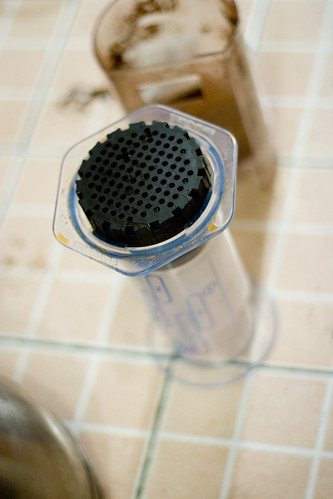
Photo Courtesy of Gabe Rodriguez
Several weeks passed and the buzz with AeroPress continued on CG. I noticed a new development with the inverted method. The stock paper filter is replaced with a polyester felt round that allows much of the aromatics and the oils to pass thru. A couple of email exchanges with Scott yielded a generous offer of samples of these poly-felt rounds for me to play with.
Following Scott's instructions, I was able to produce cups that retained the flavor and aroma, while being much cleaner than the french press. Using brewing parameters similar to a clover brew, the cup comes surprisingly close according to Jaime, and is sweeter than the french press cups. We concluded that, while being a bit clumsy and messy, this configuration (inverted + poly-felt) produces a satisfying cup that is good enough of a reason to keep this device in our array of coffee brewing apparatus.
However, after my recent visit to Taiwan, things changed a bit.
A vac pot is what I use, almost exclusively, for "brew coffee" now. The vac pot has all the advantages of my coffee brewing devices: near constant brewing temperatures, adjustable brew temperature and time, as well as a cake filtration that produces a very clean cup.
Upon learning the proper method and brewing parameters of the vac pot, I was able to produce cups that are the cleanest, most complex, and most aromatic among the three brewing methods. It also produces cups that have a long and lingering tail that stays in your mouth well after consumption. The brewing/clean-up is not much worse than the inverted poly-felt aeropress and it takes less than 5 min from grind to clean-up. The total cost of the setup is also comparable to the AeroPress.
Unfortunately, I am not aware of any US retailer selling the 2 cup version of the Hario Vac Pot. The larger vac pot units are not very desirable as you need to brew it at capacity in order to have a proper extraction. In fact, I had a 5 cup unit that I ended up gifting away due to that (there is no way in hell I can drink that much coffee without getting caffeine sickness).