This is one of my least favorite things to do. Reading a bit on the Wendelblog about re-bagging Kenyan coffee's, it reminded me how much I hate doing it.
We had a lot of Brasil coffee that were worrisome. We transferred them out of jute (as we do any coffee not sealed at origin) and had them in liner bags until we vacuum packed them a bit later when the equipment arrived. It was not fun packing. You really had to be careful how you bagged them and how you stacked them because if the seal broke, the entire purpose of repacking was lost. It took us a while to get a method down so that you could stack the 'bricks' and not worry about the pressure breaking the seal. We used nice bags and though I don't have photos to share, it is impressive to see the pallets of silver bags.
What made the Brasil so worrisome and really bothered me was every time I opened a bag to profile on the Mini, the coffee would change and fade relatively quick. We are talking about two to three weeks of time in my kitchen closet and the coffee just died. Rather strangely, this remarkably clean tasting screen dried natural became a fermenty wild 'strawberry' natural with the bready Brasil character I hate so much. A few times it even became peasy and/or dirty peanut. I doubt I will buy more Brasil in the future if I can get a good Rwanda source but that's another discussion entirely.
The weird thing was going back after six months, the vacuum packed bags are still fine though lacking that fresh character but I have a lot of half opened bags that just went nasty quick. Makes you really wonder what's going on when people say coffee can last so long or be stored in such poor conditions without them noticing an issue.
Jute is out, nitrogen flushing and vac packing is the new progressive standard.

Showing posts with label green quality. Show all posts
Showing posts with label green quality. Show all posts
Thursday, August 07, 2008
Sunday, July 13, 2008
The biggest known secret in town
I have gotten the requests for coffees via text messaging and email. When the Guatemalan coffees arrive at the end of this month, I will be sending out samples. I am a bit overextended right now trying to juggle several things so pardon the space in emails. With a little help from friends, the project is coming together as I write.
So about those Guatemalan coffees.
Earlier this year, we had an interesting venture organized in Guatemala. The idea was to identify three things: 1. Packaging 2. Sorting 3. Distribution
We wanted to know how to get the packing we wanted, the sorting we desired, at the earliest distribution point where we could still control these factors while having access to a large selection of traceable sources.
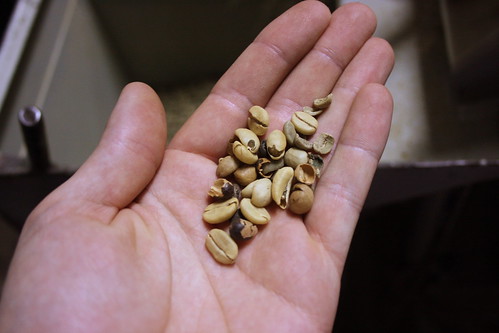 That was the idea but it quickly grew into something a bit more complicated. We became pitchmen working to get our brand access in venues which normally only deal in very large volumes. It was a tough sell but we found people willing to listen. Easiest of the three were our sorting requests. While brokers and exporters were either unsure or ambivalent about this request, it really resonated with the mill managers we met. Getting milling to better than a specialty Grade 1 sort with substantially less defects therein justifying us to call it a 'Grade Zero.' After about the third place we visited, we had a clearer idea of how distribution works, how receipts are tracked, who makes decisions, and what the demand is currently on the system. We came across the most interesting idea that sounds stupid simple. There are a lot of great coffees that go through channels we will never see. There are also so many exceptional coffees mixed in large blends that disappear, roasted into oblivion. We need to get at some of those coffees and that became a defining goal.
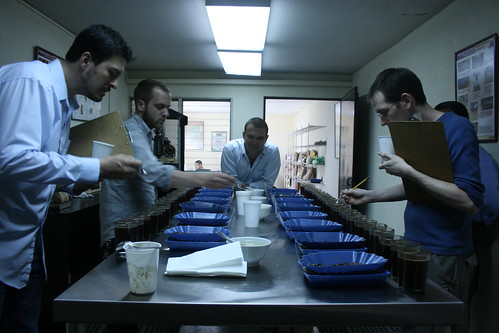 I can't think of a better place than Guatemala for this because of the range in micro climate, consistently high elevation, and clean production methods. For all the great coffees in Guatemala, they suffer one problem. The obsession with profile. Way too many people we met were focused on what the profiles should be when our simple goal was to identify the cleanest, sweetest, most aromatic and distinct. There are plenty of classic mineral acidity Guatemalan coffees though there are also so many more profiles that get blended away or devalued for lack of demand that are coffees I would pay money to have kept separate.
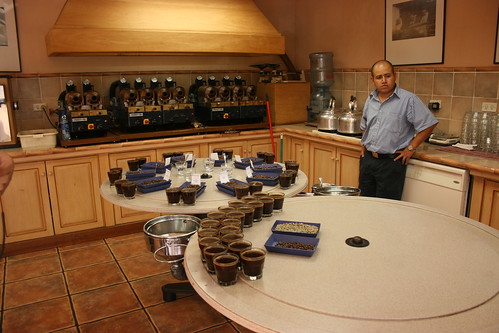 After tables and tables of coffees, and having lots broken down smaller and smaller, we found coffees we were excited about. I had to leave one behind but found an exceptional aromatic coffee with a floral rose tea like character and another that can only be described as sickly sweet, juicy, and strong aromatics and yet both from the same area. In the end, we are likely to have 5 Guatemalan coffees of which none are really similar.
The final bit which was contingent on getting the floral stuff was getting the packaging done. We were hesitant to believe this would happen but after a lot of footwork by Edwin and a bit of luck, we got the sealing together at the last minute. Multiple box designs and time spent testing led to some solid results. They ended up with 19lb vacuum sealed bags in custom cardboard boxes. These are the first coffees exported from Guatemala that are in something other than jute. To which Anacafe gets a big thanks for allowing this to happen and supporting the desire to do this. The result of these efforts is that there is now a way to get vac sealed coffees out of Guatemala be it Cup of Excellence or just something you want to protect.
Work hard to create a demand, do the footwork, and put your money where your mouth is. It may work out or it may not but you have to play it out. I'm happy with how it turned out and I can't wait until the coffees get here. I am already looking at farms to visit, new brokers willing to host, and getting in deeper next year by returning with a larger group of buyers.
So about those Guatemalan coffees.
Earlier this year, we had an interesting venture organized in Guatemala. The idea was to identify three things: 1. Packaging 2. Sorting 3. Distribution
We wanted to know how to get the packing we wanted, the sorting we desired, at the earliest distribution point where we could still control these factors while having access to a large selection of traceable sources.
That was the idea but it quickly grew into something a bit more complicated. We became pitchmen working to get our brand access in venues which normally only deal in very large volumes. It was a tough sell but we found people willing to listen. Easiest of the three were our sorting requests. While brokers and exporters were either unsure or ambivalent about this request, it really resonated with the mill managers we met. Getting milling to better than a specialty Grade 1 sort with substantially less defects therein justifying us to call it a 'Grade Zero.' After about the third place we visited, we had a clearer idea of how distribution works, how receipts are tracked, who makes decisions, and what the demand is currently on the system. We came across the most interesting idea that sounds stupid simple. There are a lot of great coffees that go through channels we will never see. There are also so many exceptional coffees mixed in large blends that disappear, roasted into oblivion. We need to get at some of those coffees and that became a defining goal.I can't think of a better place than Guatemala for this because of the range in micro climate, consistently high elevation, and clean production methods. For all the great coffees in Guatemala, they suffer one problem. The obsession with profile. Way too many people we met were focused on what the profiles should be when our simple goal was to identify the cleanest, sweetest, most aromatic and distinct. There are plenty of classic mineral acidity Guatemalan coffees though there are also so many more profiles that get blended away or devalued for lack of demand that are coffees I would pay money to have kept separate.After tables and tables of coffees, and having lots broken down smaller and smaller, we found coffees we were excited about. I had to leave one behind but found an exceptional aromatic coffee with a floral rose tea like character and another that can only be described as sickly sweet, juicy, and strong aromatics and yet both from the same area. In the end, we are likely to have 5 Guatemalan coffees of which none are really similar.The final bit which was contingent on getting the floral stuff was getting the packaging done. We were hesitant to believe this would happen but after a lot of footwork by Edwin and a bit of luck, we got the sealing together at the last minute. Multiple box designs and time spent testing led to some solid results. They ended up with 19lb vacuum sealed bags in custom cardboard boxes. These are the first coffees exported from Guatemala that are in something other than jute. To which Anacafe gets a big thanks for allowing this to happen and supporting the desire to do this. The result of these efforts is that there is now a way to get vac sealed coffees out of Guatemala be it Cup of Excellence or just something you want to protect.
Work hard to create a demand, do the footwork, and put your money where your mouth is. It may work out or it may not but you have to play it out. I'm happy with how it turned out and I can't wait until the coffees get here. I am already looking at farms to visit, new brokers willing to host, and getting in deeper next year by returning with a larger group of buyers.

Wednesday, July 09, 2008
Jamin Haddox @ Cafe Imports
The following is an interview with Jamin Haddox of Cafe Imports. This flows from conversations in early November 07. It's good that the questions asked then are still so pertinent. Jamin's boss has a scathing article on storage/transport bagging methods for green coffees in the recent issue of Roast Magazine that is worth a read. His opinion's on freezing are worth noting as they break with notable wavers on the subject. We will follow up this green storage focus with a post of our own trip to Guatemala and the success barismo has had in this area with the invaluable Mr. Martinez which addresses the last answer Jamin provided in this interview.
barismo: What is your role with Cafe imports and how long have you been with the company?
Jamin: I'm the Quality Control Manager for Café Imports. I'm in charge of the cupping lab, and am responsible for roasting, cupping, grading, and all other quality-related issues. I've been with Café Imports since September of 2006.
barismo: We talk a lot about preservation of coffee but it's a very complex topic.
What factors affect fading/aging/decay and what factors are qualified as contamination?
Jamin: It is very complex. At Café Imports, we've designed some basic experiments to help us learn and understand in more detail what these factors are. Let me point out that I'm not a scientist, but am learning, slowly, what some of these factors may be. A lot of things can cause coffee to age, including its own respiratory processes as it sits after processing. Free moisture and water activity play a key factor in coffee flavor deterioration. Water activity is a way to describe water's specific energy, which can be explained in simpler terms as how stable the free moisture is inside the coffee. Put another way, water activity can describe how willing water is to enter or leave the bean. Water bonds readily to volatile chemicals in coffee, many of which are responsible for coffee's unique flavors and positive cup attributes. So water in coffee can act like a transport mechanism, carrying materials either in or out of the bean. Once volatiles are transported to the surface of the bean, they are oxidized or evaporate, and you can never recover that loss. Eventually all desirable compounds are lost or transformed, leaving mainly the cellulose structure of the bean. Many call this "baggy" or "wet cardboard", which is essentially, all that's left.
We don't consider oldish flavors in a past crop coffee to be contamination or defect, but rather an expected and accepted part of coffee "fading" in un-protected jute. However, in a new crop coffee, we would never accept a coffee that exhibited signs of oldishness or "baggy" jute flavors.
As far as contamination is concerned, there are a lot of weird flavors that can end up in coffee. We recently cupped an incredibly floral central American coffee, and learned that somehow handsoap had been spilled on the bag prior to shipment and the artificial fragrance had leeched through the plastic sample bag and into the coffee. This fragrance survived the roast and ended up in the cup. Coffee is hygroscopic and will soak up almost anything placed next to it and store this contamination mainly in its fats. Some countries treat jute with a petroleum-based preservative which imparts a fumy, menthol and diesel flavor to the cup. Many times, the first indication of contamination can be detected from simply smelling the green beans prior to roasting.
We want to find ways to preserve coffee's nuance and delicate flavors. Coffee that's only 3 months off the tree should still taste fresh and vibrant, but many times this is not the case. Coffee is easily damaged by fluctuation in temperature and humidity, and can suffer considerable loss of quality during transport from origin to its destination alone. This is so common in the industry, that many cuppers (including myself at times) fail to recognize it in the cup. Most coffee shops would never accept stale pastries from their baker, yet they sell old coffee (green as well as roasted) all the time. The question that we're interested in exploring is how to minimize fading in green coffee in a realistic and sustainable way. What are the ideal storage conditions for green and how much fading naturally occurs under ideal storage conditions verses how much do we enforce and expedite because of careless practices and lack of good information?
barismo: Moisture appears the biggest problem in green, can you detail some byproducts of moisture problems?
Jamin: Mold growth is probably the biggest problem. Mold growth can occur in green coffee when water activity in the bean is at favorable levels to support mold growth. Mold growth can lead to Orchratoxin contamination in green coffee. This is regulated quite heavily in Europe and other countries around the world (though not in the US), since Ochratoxin A is a mycotoxin that has been shown to cause renal toxicity and liver and kidney cancer. Most studies I've seen involving mold and roasted coffee, however, refer to the fate of Ochratoxin A during further processing (roasting, brewing, etc.).
Other problems include flavor taints, or loss of flavor, as described earlier. Mold is a terrible thing to taste in coffee.
barismo: We have focused a lot on defects (not taints) on the small scale and have actually noted increases in pales, molds, and other discolorations as coffees age, can you elaborate on this phenomena and what roasters can do to slow or stop this once coffees are to be warehoused?
Jamin: Coffee that is improperly dried at origin can exhibit these characteristics. Also, coffee that is stored in high humidity can mold and change color. Certain coffees from Indonesia are shipped with very high initial moisture. These coffees are less stable and can break down, discolor, or mold more readily than properly dried coffee. They are also more susceptible to insect damage. Coffee that has been exposed to extremes in temperature and humidity, especially large fluctuations, can also exhibit these traits.
barismo: Can you detail the hermetic grain tent (GrainPro)at origin idea?
Jamin: I can offer a brief explanation. Storing coffee at origin can be challenging because of infrastructure and lack of adequate storage conditions. GrainPro, Inc. is a company that manufactures products mainly for the seed industry and has a product for preserving food sources such as grain and seed in countries of origin, mainly in the third world. They've developed a tent or "cocoon" for controlling temperature and humidity for storage of bulk coffee at origin. Coffee in parchment is placed into shipping container-sized cocoons that are designed much like a Hazmat suit with special zippers and a layer of nearly-impermeable plastic. These can be set up outdoors with a refractive tarp for shade and seal hermetically to keep pests and other maladies at bay. An interesting side effect of hermetically sealing coffee, however, is that the natural respiration of the coffee actually flushes the chamber with CO2, creating an almost ideal environment for coffee storage while killing insects and molds. Studies have been undertaken that show almost no decrease in cup quality or moisture content of coffee stored this way for 9 months.
barismo: Freezing is a controversial topic. Can you detail current investigations into freezing, flash freezing, and related thawing issues?
Jamin: Freezing is controversial, and I don't have enough direct experience to feel comfortable commenting on this.
barismo: What are the issues we face economically and customs related in supplanting jute as a packing material?
Jamin: Jute has some great things going for it: It's cheap, and relative to other man-made products, especially petroleum based plastics, it is environmentally friendly. The drawback is that it provides almost no protection from environmental conditions that are detrimental to coffee quality. Coffee is largely a cost-driven economy, with few willing to compete on quality. Like anything, there must be a desire within the market for emerging storage technologies, and a willingness to embrace the pricing changes that this would certainly demand, before this will be explored seriously by those able to provide it.
barismo: What is your role with Cafe imports and how long have you been with the company?
Jamin: I'm the Quality Control Manager for Café Imports. I'm in charge of the cupping lab, and am responsible for roasting, cupping, grading, and all other quality-related issues. I've been with Café Imports since September of 2006.
barismo: We talk a lot about preservation of coffee but it's a very complex topic.
What factors affect fading/aging/decay and what factors are qualified as contamination?
Jamin: It is very complex. At Café Imports, we've designed some basic experiments to help us learn and understand in more detail what these factors are. Let me point out that I'm not a scientist, but am learning, slowly, what some of these factors may be. A lot of things can cause coffee to age, including its own respiratory processes as it sits after processing. Free moisture and water activity play a key factor in coffee flavor deterioration. Water activity is a way to describe water's specific energy, which can be explained in simpler terms as how stable the free moisture is inside the coffee. Put another way, water activity can describe how willing water is to enter or leave the bean. Water bonds readily to volatile chemicals in coffee, many of which are responsible for coffee's unique flavors and positive cup attributes. So water in coffee can act like a transport mechanism, carrying materials either in or out of the bean. Once volatiles are transported to the surface of the bean, they are oxidized or evaporate, and you can never recover that loss. Eventually all desirable compounds are lost or transformed, leaving mainly the cellulose structure of the bean. Many call this "baggy" or "wet cardboard", which is essentially, all that's left.
We don't consider oldish flavors in a past crop coffee to be contamination or defect, but rather an expected and accepted part of coffee "fading" in un-protected jute. However, in a new crop coffee, we would never accept a coffee that exhibited signs of oldishness or "baggy" jute flavors.
As far as contamination is concerned, there are a lot of weird flavors that can end up in coffee. We recently cupped an incredibly floral central American coffee, and learned that somehow handsoap had been spilled on the bag prior to shipment and the artificial fragrance had leeched through the plastic sample bag and into the coffee. This fragrance survived the roast and ended up in the cup. Coffee is hygroscopic and will soak up almost anything placed next to it and store this contamination mainly in its fats. Some countries treat jute with a petroleum-based preservative which imparts a fumy, menthol and diesel flavor to the cup. Many times, the first indication of contamination can be detected from simply smelling the green beans prior to roasting.
We want to find ways to preserve coffee's nuance and delicate flavors. Coffee that's only 3 months off the tree should still taste fresh and vibrant, but many times this is not the case. Coffee is easily damaged by fluctuation in temperature and humidity, and can suffer considerable loss of quality during transport from origin to its destination alone. This is so common in the industry, that many cuppers (including myself at times) fail to recognize it in the cup. Most coffee shops would never accept stale pastries from their baker, yet they sell old coffee (green as well as roasted) all the time. The question that we're interested in exploring is how to minimize fading in green coffee in a realistic and sustainable way. What are the ideal storage conditions for green and how much fading naturally occurs under ideal storage conditions verses how much do we enforce and expedite because of careless practices and lack of good information?
barismo: Moisture appears the biggest problem in green, can you detail some byproducts of moisture problems?
Jamin: Mold growth is probably the biggest problem. Mold growth can occur in green coffee when water activity in the bean is at favorable levels to support mold growth. Mold growth can lead to Orchratoxin contamination in green coffee. This is regulated quite heavily in Europe and other countries around the world (though not in the US), since Ochratoxin A is a mycotoxin that has been shown to cause renal toxicity and liver and kidney cancer. Most studies I've seen involving mold and roasted coffee, however, refer to the fate of Ochratoxin A during further processing (roasting, brewing, etc.).
Other problems include flavor taints, or loss of flavor, as described earlier. Mold is a terrible thing to taste in coffee.
barismo: We have focused a lot on defects (not taints) on the small scale and have actually noted increases in pales, molds, and other discolorations as coffees age, can you elaborate on this phenomena and what roasters can do to slow or stop this once coffees are to be warehoused?
Jamin: Coffee that is improperly dried at origin can exhibit these characteristics. Also, coffee that is stored in high humidity can mold and change color. Certain coffees from Indonesia are shipped with very high initial moisture. These coffees are less stable and can break down, discolor, or mold more readily than properly dried coffee. They are also more susceptible to insect damage. Coffee that has been exposed to extremes in temperature and humidity, especially large fluctuations, can also exhibit these traits.
barismo: Can you detail the hermetic grain tent (GrainPro)at origin idea?
Jamin: I can offer a brief explanation. Storing coffee at origin can be challenging because of infrastructure and lack of adequate storage conditions. GrainPro, Inc. is a company that manufactures products mainly for the seed industry and has a product for preserving food sources such as grain and seed in countries of origin, mainly in the third world. They've developed a tent or "cocoon" for controlling temperature and humidity for storage of bulk coffee at origin. Coffee in parchment is placed into shipping container-sized cocoons that are designed much like a Hazmat suit with special zippers and a layer of nearly-impermeable plastic. These can be set up outdoors with a refractive tarp for shade and seal hermetically to keep pests and other maladies at bay. An interesting side effect of hermetically sealing coffee, however, is that the natural respiration of the coffee actually flushes the chamber with CO2, creating an almost ideal environment for coffee storage while killing insects and molds. Studies have been undertaken that show almost no decrease in cup quality or moisture content of coffee stored this way for 9 months.
barismo: Freezing is a controversial topic. Can you detail current investigations into freezing, flash freezing, and related thawing issues?
Jamin: Freezing is controversial, and I don't have enough direct experience to feel comfortable commenting on this.
barismo: What are the issues we face economically and customs related in supplanting jute as a packing material?
Jamin: Jute has some great things going for it: It's cheap, and relative to other man-made products, especially petroleum based plastics, it is environmentally friendly. The drawback is that it provides almost no protection from environmental conditions that are detrimental to coffee quality. Coffee is largely a cost-driven economy, with few willing to compete on quality. Like anything, there must be a desire within the market for emerging storage technologies, and a willingness to embrace the pricing changes that this would certainly demand, before this will be explored seriously by those able to provide it.
Thursday, March 27, 2008
Romancing the cup

What if you took a good coffee... and preserved it? A solid 90pt cup. Strong sweetness. Good pleasant fruit. Clean and well processed on the patio. Strong aromatics and a sugary finish.
You find that coffee at origin and then you mill it to higher than specialty grade standards, let's call it grade zero.
You pack it progressively and preserve the coffees, vacuum seal and keep degradation and contamination issues at bay.
A fresh cup, prepped well, preserved on the way from the farm to the roaster. An interesting idea. No sexy brand names, just focus on keeping unique cups as close to the farm gate flavor as possible.
What would you pay for this? What value would it add to the cup? What would the coffees taste like and how different would they be from the same coffees prepped at specialty grade with 5 defects per sample in jute and normal packing?
Saturday, January 12, 2008
The mighty Yirg
Today we cupped another Yirgacheffe WP. This is the most frustrating of coffees because here in the US, we seem to only get Gr2 and often large sub par 'FTO' lots. The lots are of oddly misshapen or broken beans, poorly screened with high defect rates and yet they still get a grade 2 marking. It's as if all the rejects from grade 1 are dumped into grade 2 and we just oblige.
The last Yirgacheffe we cupped was the Konga Coop lot a bunch of people have right now. It's faded and pales are abundant which screams of past crop. The defect rate is high and yet, if you cleaned it up AND it was still fresh, this might be a pretty good Yirg. The commercial roast we had was for espresso and not only simply dark, it had a pungent gassiness that yielded to a sharpness simply unpleasant as espresso. It only came out bearable as a tight ristretto but there was a grapefruit bitter in the cup that was obstructing the still present dried fruit aromas of apricot and jasmine.
The Yirg we sampled just before that was a FTO offering that just tasted only of jute bag. Nothing more, nothing less. Those are normal Yirg experiences for us.
The Yirgacheffe we cupped tonight though was a bit different and it reaffirmed a love for this origin. It still had a lot of issues needing cleaning up being Gr2 but also being fresh, it still had solid aromatic character. The attrition rate to clean it up is almost 50% if your are being absolute, but the cup was potently complex and showed us the simple fact that Yirgacheffe can still beat down most coffees on complexity of aroma. It was a rounded concord grape note with a dried fruit tea character, hint of ginger, and a popping floral, even in the grounds. The cup was toned with rounded fruit and soft sweetness, simply ripe. Of course, this was a Simon Hsieh production roast which seems to defy logic at times so it could be a bit of that played a role but in a lineup of 5 coffees, it floored us as one of the best cups I have had all year. The kind of aroma you taste in the back of your throat, it was that good.
The Yirgacheffe situation is strange for what may be one of the best but most misunderstood coffees around. It is a hard coffee to roast well. It burns easily and the aromas are quick to be baked out. As our North American culture is moving more and more towards the simplistic notes of fermented Sidamos and all variations of dry processed coffees, the washed Yirgs are lost on us.
I wonder if there are these great washed Yirgs that just get gobbled up by Europe or the Japanese alone! There must be smaller lots than the massive grade 2 lots we keep seeing stateside, right? It's complex and I don't profess to understand it but I love a good Yirg and yet I have only had two great experiences to shape that belief.
Should I then buy green of this Yirg which has many issues and try to live with it? Or should I simply avoid buying a coffee that has problems and focus on the Kenya AA and nice Rwanda lots available at higher prices? I don't have the ability to run it through the mill's electronic eye and remove all the broken bits, molds, bug bites, pales, etc... so I'm lost on exactly what I would do with it if I did buy it, but I love the washed Yirg's and know what the coffee could be if cleaned up and roasted well so I'm in a dilemma...
The last Yirgacheffe we cupped was the Konga Coop lot a bunch of people have right now. It's faded and pales are abundant which screams of past crop. The defect rate is high and yet, if you cleaned it up AND it was still fresh, this might be a pretty good Yirg. The commercial roast we had was for espresso and not only simply dark, it had a pungent gassiness that yielded to a sharpness simply unpleasant as espresso. It only came out bearable as a tight ristretto but there was a grapefruit bitter in the cup that was obstructing the still present dried fruit aromas of apricot and jasmine.
The Yirg we sampled just before that was a FTO offering that just tasted only of jute bag. Nothing more, nothing less. Those are normal Yirg experiences for us.
The Yirgacheffe we cupped tonight though was a bit different and it reaffirmed a love for this origin. It still had a lot of issues needing cleaning up being Gr2 but also being fresh, it still had solid aromatic character. The attrition rate to clean it up is almost 50% if your are being absolute, but the cup was potently complex and showed us the simple fact that Yirgacheffe can still beat down most coffees on complexity of aroma. It was a rounded concord grape note with a dried fruit tea character, hint of ginger, and a popping floral, even in the grounds. The cup was toned with rounded fruit and soft sweetness, simply ripe. Of course, this was a Simon Hsieh production roast which seems to defy logic at times so it could be a bit of that played a role but in a lineup of 5 coffees, it floored us as one of the best cups I have had all year. The kind of aroma you taste in the back of your throat, it was that good.
The Yirgacheffe situation is strange for what may be one of the best but most misunderstood coffees around. It is a hard coffee to roast well. It burns easily and the aromas are quick to be baked out. As our North American culture is moving more and more towards the simplistic notes of fermented Sidamos and all variations of dry processed coffees, the washed Yirgs are lost on us.
I wonder if there are these great washed Yirgs that just get gobbled up by Europe or the Japanese alone! There must be smaller lots than the massive grade 2 lots we keep seeing stateside, right? It's complex and I don't profess to understand it but I love a good Yirg and yet I have only had two great experiences to shape that belief.
Should I then buy green of this Yirg which has many issues and try to live with it? Or should I simply avoid buying a coffee that has problems and focus on the Kenya AA and nice Rwanda lots available at higher prices? I don't have the ability to run it through the mill's electronic eye and remove all the broken bits, molds, bug bites, pales, etc... so I'm lost on exactly what I would do with it if I did buy it, but I love the washed Yirg's and know what the coffee could be if cleaned up and roasted well so I'm in a dilemma...
Tuesday, May 29, 2007
Pandora's Box
'You take the blue pill and the story ends. You wake in your bed and believe whatever you want to believe. You take the red pill and you stay in Wonderland and I show you how deep the rabbit-hole goes. Remember -- all I am offering is the truth, nothing more.' - Morpheus, The Matrix
Ever wonder why not many ppl talk about green quality?
This question has been bugging me quite a lot lately. If you read any of the online forums, you will notice that so much focus was on the machines and barista techniques. The coffee itself is actually not often discussed, and those who do seem to love what they are tasting.
I really don't understand what is going on? Most of the coffee I sample these day pains me. With few exceptions, I found most don't live up to the fantastic description written on the bags/cupping notes. What are these ppl tasting? Is my palate so flawed that I could not pick up all the wonderful things that most are tasting? Why am I tasting so many defects?
I dunno.
Since April of this year, we have been roasting seriously and starting to pay attention to green quality (and everything that is wrong with it). Here are things that I've learned thus far:
- Roasting light reveals everything. The good, the bad, and the ugly. Green defects and age will shout at you loudly. Roast defects (mostly improper drying) will slap you in the face.
- Defects taste bad.
- Contrary to some ppl's belief, a well sorted defect-free green actually enhances complexity. The "definition" of the coffee increases as a result of clarity, and all flavor components are more focused and pronounced.
- Agey green sucks. It make the coffee taste like cheerio when roasted light, and taste like wood when roasted dark. Interestingly, that woody note tastes EXACTLY "like coffee". It's the generic flavor you find in extracts and gas station coffees.
- There is a direct correlation between how the green smells and the roasted coffee tastes. In fact, when roasted correctly, the green aroma components carry over to the roasted beans.
- Specialty grade coffee is not so special at all. Most are loaded with defects. Sit down and pick thru your beans. You will be surprised at how much crap is in there. The nastiest stuff I've seen so far are some beans from a "new crop" of Antigua that has fuzzy molds growing on it. It really made me sick to think I drank these before.
- Good quality greens do exit. Additional green sorting, vacuum packing, and air freighting are all options available - you just need to demand it and pay for it. The really good stuff is gobbled up by the Japanese and the Scandinavians.
Just like any food product, quality starts with raw ingredients. Everything you do afterwards is merely preserving and revealing the quality inside. There is nothing you can do to make a crappy green taste good - you can roast in such way to make it drinkable, but what's the point of shooting for the lowest common denominator?
So if green quality dictates the majority of what's in the cup, then how come not many are stressing over it? I think it's an accumulation of things that make it this way:
- Ppl don't really roast light - most of the "problems" are covered up this way.
- Ppl don't have the chance to taste defects - they end up associating it and accepting defect tastes as part of the coffee flavor.
- Ppl never truly sit down and get to know their beans. If they do, they are either oblivious to the problems or choose to ignore it.
Understanding green quality turns out to be one of the definitive turning points in my coffee experience. I truly did not know the kind of problem I would discover. Once your eyes are open, it's very scary and the light at the end of tunnel seemed so far away. There were so many issues and the lack of access often make me feel helpless. Suddenly, all these focus on equipments and barista techniques seemed meaningless - nothing really matters if I don't even have good ingredients to work with.
Will you choose the blue or the red pill? Are you prepared to face the demons from Pandora's box?
- Ben C.
Ever wonder why not many ppl talk about green quality?
This question has been bugging me quite a lot lately. If you read any of the online forums, you will notice that so much focus was on the machines and barista techniques. The coffee itself is actually not often discussed, and those who do seem to love what they are tasting.
I really don't understand what is going on? Most of the coffee I sample these day pains me. With few exceptions, I found most don't live up to the fantastic description written on the bags/cupping notes. What are these ppl tasting? Is my palate so flawed that I could not pick up all the wonderful things that most are tasting? Why am I tasting so many defects?
I dunno.
Since April of this year, we have been roasting seriously and starting to pay attention to green quality (and everything that is wrong with it). Here are things that I've learned thus far:
- Roasting light reveals everything. The good, the bad, and the ugly. Green defects and age will shout at you loudly. Roast defects (mostly improper drying) will slap you in the face.
- Defects taste bad.
- Contrary to some ppl's belief, a well sorted defect-free green actually enhances complexity. The "definition" of the coffee increases as a result of clarity, and all flavor components are more focused and pronounced.
- Agey green sucks. It make the coffee taste like cheerio when roasted light, and taste like wood when roasted dark. Interestingly, that woody note tastes EXACTLY "like coffee". It's the generic flavor you find in extracts and gas station coffees.
- There is a direct correlation between how the green smells and the roasted coffee tastes. In fact, when roasted correctly, the green aroma components carry over to the roasted beans.
- Specialty grade coffee is not so special at all. Most are loaded with defects. Sit down and pick thru your beans. You will be surprised at how much crap is in there. The nastiest stuff I've seen so far are some beans from a "new crop" of Antigua that has fuzzy molds growing on it. It really made me sick to think I drank these before.
- Good quality greens do exit. Additional green sorting, vacuum packing, and air freighting are all options available - you just need to demand it and pay for it. The really good stuff is gobbled up by the Japanese and the Scandinavians.
Just like any food product, quality starts with raw ingredients. Everything you do afterwards is merely preserving and revealing the quality inside. There is nothing you can do to make a crappy green taste good - you can roast in such way to make it drinkable, but what's the point of shooting for the lowest common denominator?
So if green quality dictates the majority of what's in the cup, then how come not many are stressing over it? I think it's an accumulation of things that make it this way:
- Ppl don't really roast light - most of the "problems" are covered up this way.
- Ppl don't have the chance to taste defects - they end up associating it and accepting defect tastes as part of the coffee flavor.
- Ppl never truly sit down and get to know their beans. If they do, they are either oblivious to the problems or choose to ignore it.
Understanding green quality turns out to be one of the definitive turning points in my coffee experience. I truly did not know the kind of problem I would discover. Once your eyes are open, it's very scary and the light at the end of tunnel seemed so far away. There were so many issues and the lack of access often make me feel helpless. Suddenly, all these focus on equipments and barista techniques seemed meaningless - nothing really matters if I don't even have good ingredients to work with.
Will you choose the blue or the red pill? Are you prepared to face the demons from Pandora's box?
- Ben C.
Wednesday, May 16, 2007
Hello, are you there quality?
From conversations on coffeed:
'I've been told that taste is the only morality. I've since disagreed. I love the taste of those cheap pecan spinwheels you can find nearly anywhere. The problem, is that the quality is extremely low. A whole lot of people love the taste of coffee and chocolate iced milkshakes. The problem, is that the quality just isn't there. A lot of people love dirty coffees. The problem, is that the highest possible quality just isn't there. Are we promoting "what you like", or are we promoting quality? If it's just about "what you like", then maybe Starbucks is onto something.' -Jason Haeger
A lot of times in coffee, I think people misunderstand our little site here at barismo. I remember Ben talking about how on one European forum a participant insisted our review of aeropress missed the 'obvious' fact that it was convenient and our preference for vac pot was like lugging around lab equipment. The truth is convenience is for someone else's site. We want the best of the best in terms of coffees and brew methods. Sure there's subjectivity in that but it also means we are willing to forgo convenience for a substantially better cup of brewed coffee.
I think that applies to all coffee because great coffee isn't easy or simple. I think the problem is that there are multitudes of people on forums and websites all professing that what they serve at home or in shop is the best of the best. Some may be right but a lot of others are simply getting the most out of what they have, not necessarily the best.
'Jason makes an important point. Most coffee drinkers in the world don't really understand coffee and have little to no experience with 'high quality'. They've never tasted it, don't know it's out there, and in most cases don't have any immediate access to it. One way to look at this whole issue is that it is our job as coffee professionals to take them by the hand and lead them to the well...(continued a must read!)' - Geoff Watts
The coffees that win awards and garner top honors for being the 'least coffee-like' are the coffees I find intriguing. Those are the coffees I want to promote and talk about. The processing requires skill and intensive labor to prepare an exceptional cup, something lesser coffees do not. That's why Sumatra and Harrars don't interest me.
Not to mis-inform people (particularly googlers!) by simply saying they suck, I truly just don't believe the quality is there. Maybe that means I will have a lot of headaches finding 'good' coffees but I'd rather not drink it unless it's going to be a great cup.
Same goes for tea in case you were wondering.
'I've been told that taste is the only morality. I've since disagreed. I love the taste of those cheap pecan spinwheels you can find nearly anywhere. The problem, is that the quality is extremely low. A whole lot of people love the taste of coffee and chocolate iced milkshakes. The problem, is that the quality just isn't there. A lot of people love dirty coffees. The problem, is that the highest possible quality just isn't there. Are we promoting "what you like", or are we promoting quality? If it's just about "what you like", then maybe Starbucks is onto something.' -Jason Haeger
A lot of times in coffee, I think people misunderstand our little site here at barismo. I remember Ben talking about how on one European forum a participant insisted our review of aeropress missed the 'obvious' fact that it was convenient and our preference for vac pot was like lugging around lab equipment. The truth is convenience is for someone else's site. We want the best of the best in terms of coffees and brew methods. Sure there's subjectivity in that but it also means we are willing to forgo convenience for a substantially better cup of brewed coffee.
I think that applies to all coffee because great coffee isn't easy or simple. I think the problem is that there are multitudes of people on forums and websites all professing that what they serve at home or in shop is the best of the best. Some may be right but a lot of others are simply getting the most out of what they have, not necessarily the best.
'Jason makes an important point. Most coffee drinkers in the world don't really understand coffee and have little to no experience with 'high quality'. They've never tasted it, don't know it's out there, and in most cases don't have any immediate access to it. One way to look at this whole issue is that it is our job as coffee professionals to take them by the hand and lead them to the well...(continued a must read!)' - Geoff Watts
The coffees that win awards and garner top honors for being the 'least coffee-like' are the coffees I find intriguing. Those are the coffees I want to promote and talk about. The processing requires skill and intensive labor to prepare an exceptional cup, something lesser coffees do not. That's why Sumatra and Harrars don't interest me.
Not to mis-inform people (particularly googlers!) by simply saying they suck, I truly just don't believe the quality is there. Maybe that means I will have a lot of headaches finding 'good' coffees but I'd rather not drink it unless it's going to be a great cup.
Same goes for tea in case you were wondering.
Friday, May 11, 2007
Seasonal coffee and preserving quality.
Coffee is an agricultural product and due to the multitude of growing regions throughout the world, it has multiple harvest dates through the year. The question I ponder today: when is coffee 'in season?'
I glanced at a forum post by Geoff Watts of Intelligentsia where he briefly touched on the facts that coffees, especially high grade coffees can degrade quickly.
"...coffees that campaign on a platform of delicate floral or fruit notes and seductive aromatics usually have a much more limited time frame within which to impress. Those are the first things to go when Chronos comes knocking, and are sitting on the beach getting a suntan long before any hint of woodiness or paper shows up. Another thing to consider is the original quality level of the coffee. Like Jimmy says, the harder they come they harder they fall. A coffee that earns a 94 in May might be closer to 87 by December, whereas one that starts at 82 might only slide to 79 in the same time frame. It's like the supermodel/beauty queen syndrome--most of these models/actresses are in their teens and twenties. Forty is geriatric by those industry standards, whereas your average person can still be considered quite attractive and vital at that age." Geoff
I know some people will disagree with that. Still others will agree then point out coffee being a seasonal crop which must be served 'in season.' Then there are others who are pushing that we simply abandon jute bags and do much more to preserve great coffees that believe the lifespan of a great coffee is much shorter.
I count myself as the latter. A sample of green for our green storage project that was open has already faded and lost considerable color and aroma. My initial fear is that our home style vac setup and freezing method are only able to slow age rather than stop any significant amount of aging.
The argument that irritates me enough to write is simply the 'seasonality of coffee' argument. Coffee is produced around seasons but I wonder if it is ever really in season. Simply put, we often get the coffees months after harvest, when are we ever really drinking something that is in season? Maybe the 'in' season is 3-6 months after harvest, after the coffee has sat in jute bags on docks or in transport on ships or over land for several months before we cup it.
It takes a series of steps to notice age in a coffee. You first have to be exposed to 'fresher' coffees that are very close to harvest and cup them regularly. This largely depends on sampling coffees from a roaster who air shipped a coffee or vac sealed it at origin or simply carrying back some high grade green coffee from origin. You must then roast in a manner that you would notice the floral and fruit slipping away and turning into woody notes aka 'the generic stale coffee taste.' You would also then have to value that fruit and floral aroma as a key component of the cup to value it at the same time devaluing the woodiness of age. Many who value body over fruit and floral would simply never roast in such a manner as to notice the fruit. The wild cup lovers on the other hand are simply not working with coffees upon which it makes a big difference either way.
While I quote Geoff, I think he is one of the people who could use his influence to push for those changes in transport and bagging for many of the farms he works directly with as well as in the industry overall. The problem is, it comes down to a definition of quality. A balance of what is acceptable financially vs an ideal. Acknowledging a problem and actually doing something about it are two different things.
How do you really define quality in coffee?
As Simon mentions to us often, it's the total package when you talk about quality. As a North American industry, we always chest thump about quality but it comes down to the entire product from seed to cup and preserving that quality... It's not simply the barista skills, equipment mods, and 'artisan' roasting. As Edwin often points out, coffee is a product in which we strive to preserve value along the way. We cannot intrinsically add value, we can only preserve what was in the 'finished' product at the farm.
Preserve quality. It's an interesting thought.
I glanced at a forum post by Geoff Watts of Intelligentsia where he briefly touched on the facts that coffees, especially high grade coffees can degrade quickly.
"...coffees that campaign on a platform of delicate floral or fruit notes and seductive aromatics usually have a much more limited time frame within which to impress. Those are the first things to go when Chronos comes knocking, and are sitting on the beach getting a suntan long before any hint of woodiness or paper shows up. Another thing to consider is the original quality level of the coffee. Like Jimmy says, the harder they come they harder they fall. A coffee that earns a 94 in May might be closer to 87 by December, whereas one that starts at 82 might only slide to 79 in the same time frame. It's like the supermodel/beauty queen syndrome--most of these models/actresses are in their teens and twenties. Forty is geriatric by those industry standards, whereas your average person can still be considered quite attractive and vital at that age." Geoff
I know some people will disagree with that. Still others will agree then point out coffee being a seasonal crop which must be served 'in season.' Then there are others who are pushing that we simply abandon jute bags and do much more to preserve great coffees that believe the lifespan of a great coffee is much shorter.
I count myself as the latter. A sample of green for our green storage project that was open has already faded and lost considerable color and aroma. My initial fear is that our home style vac setup and freezing method are only able to slow age rather than stop any significant amount of aging.
The argument that irritates me enough to write is simply the 'seasonality of coffee' argument. Coffee is produced around seasons but I wonder if it is ever really in season. Simply put, we often get the coffees months after harvest, when are we ever really drinking something that is in season? Maybe the 'in' season is 3-6 months after harvest, after the coffee has sat in jute bags on docks or in transport on ships or over land for several months before we cup it.
It takes a series of steps to notice age in a coffee. You first have to be exposed to 'fresher' coffees that are very close to harvest and cup them regularly. This largely depends on sampling coffees from a roaster who air shipped a coffee or vac sealed it at origin or simply carrying back some high grade green coffee from origin. You must then roast in a manner that you would notice the floral and fruit slipping away and turning into woody notes aka 'the generic stale coffee taste.' You would also then have to value that fruit and floral aroma as a key component of the cup to value it at the same time devaluing the woodiness of age. Many who value body over fruit and floral would simply never roast in such a manner as to notice the fruit. The wild cup lovers on the other hand are simply not working with coffees upon which it makes a big difference either way.
While I quote Geoff, I think he is one of the people who could use his influence to push for those changes in transport and bagging for many of the farms he works directly with as well as in the industry overall. The problem is, it comes down to a definition of quality. A balance of what is acceptable financially vs an ideal. Acknowledging a problem and actually doing something about it are two different things.
How do you really define quality in coffee?
As Simon mentions to us often, it's the total package when you talk about quality. As a North American industry, we always chest thump about quality but it comes down to the entire product from seed to cup and preserving that quality... It's not simply the barista skills, equipment mods, and 'artisan' roasting. As Edwin often points out, coffee is a product in which we strive to preserve value along the way. We cannot intrinsically add value, we can only preserve what was in the 'finished' product at the farm.
Preserve quality. It's an interesting thought.
Wednesday, April 11, 2007
Cupping coffee and the stinky bean
Stinkers: Stinker beans are generally caused as a result of over-fermentation, and due to improper cleaning of fermentation tanks and washing channels. Beans adhering to the pulper vats, if not cleaned meticulously, become stinkers. Stinker beans, when crushed or cut, emanate a very unpleasant odor. They taint the liquor, producing an unpleasant taste in the cup, and give a flavor described as 'over-fermented', 'unclean' or even 'foul'. One or two stinker beans can contaminate and spoil a whole batch of coffee. See also 'Discoloured', under 'Defects – Appearance / Coloration', above. - coffee-ota.org
There are times when coffee is fun and there are times when it is a lot of work. Cupping through slight roast variances from one single coffee roasted several times that when charted out look almost identical is definitely work.
I ran across this one thing that was just disgusting. A stinky bean (or two). Out of a dozen roasts and multiple bags, this showed up in two cups only.
Dry aroma, Skunk. Wet aroma like body odor. Taste was like 'someone brewed the coffee with toenail clippings.' Completely disgusting and foul. Out of six cups, two had this and I suspect it was because they were ground one after another.
I have never really cupped this before and yet this was so distinct in those two cups alone that it led me to realize why it is so essential to cup 3-6 cups of every coffee evaluated on a table.
Ouch!
There are times when coffee is fun and there are times when it is a lot of work. Cupping through slight roast variances from one single coffee roasted several times that when charted out look almost identical is definitely work.
I ran across this one thing that was just disgusting. A stinky bean (or two). Out of a dozen roasts and multiple bags, this showed up in two cups only.
Dry aroma, Skunk. Wet aroma like body odor. Taste was like 'someone brewed the coffee with toenail clippings.' Completely disgusting and foul. Out of six cups, two had this and I suspect it was because they were ground one after another.
I have never really cupped this before and yet this was so distinct in those two cups alone that it led me to realize why it is so essential to cup 3-6 cups of every coffee evaluated on a table.
Ouch!
Monday, January 15, 2007
Super Hard Bean!
It's SHB. Super hard bean. Strictly Hard Bean. Strictly high grown dense beans... no matter what you will call it, they are the good stuff. The dense little buggers that wear grinders down quicker but pack a flavorful punch!
So what about hard beans?
I'm headed off to Guatemala in a week as part of Edwin and Aaron's barista trip. Edwin is leading some work on storage that Aaron and I are priveleged to help out on. Got a couple of blinds lined up to help out and it should be interesting stuff. I got a bag of green from Edwin to roast pre-trip and I need to sort out a lot of side things before going. This is going to be a busy week.
I will follow up on the experiment when Edwin sets us up with the green, Aaron may write an article if things go well.
Keep an eye on it. I am feeling the pressure, but I know that's just part of the growing phase for me in this business.
Looking forward to some Guatemala SHB... :p
So what about hard beans?
I'm headed off to Guatemala in a week as part of Edwin and Aaron's barista trip. Edwin is leading some work on storage that Aaron and I are priveleged to help out on. Got a couple of blinds lined up to help out and it should be interesting stuff. I got a bag of green from Edwin to roast pre-trip and I need to sort out a lot of side things before going. This is going to be a busy week.
I will follow up on the experiment when Edwin sets us up with the green, Aaron may write an article if things go well.
Keep an eye on it. I am feeling the pressure, but I know that's just part of the growing phase for me in this business.
Looking forward to some Guatemala SHB... :p
Subscribe to:
Comments (Atom)