"A sommelier (pronounced /sɔməˈlje/ or suh-mal-'yAy), or wine steward, is a trained and knowledgeable wine professional, commonly working in fine restaurants, who specializes in all facets of wine service. The role is more specialised and informed than that of a wine waiter." -Wikipedia
When will such a thing exist in coffee? A culinary professional on par with a Chef de Cuisine. The first proclaimed tea sommelier happened only around a decade ago. Will such a title apply to a coffee professional in the near future? Someone to help tweak every little flavor from each varietal. A trained professional who understands all aspects of production well enough to be considered a master.
How far away from this are we in coffee?
There are great barista working with a single blend, but few work with enough different espresso/coffees to build a good understanding of different roast styles, origins, and varied extraction methods. Many of the most elite have only ever worked with one roaster consistently and would be hard pressed to adjust to or even simply accept different styles to get the most form a coffee.
Especially as all these new Cup of Excellence coffees come out and change the true specialty market, how can we as consumers keep up without someone to help us get the most from these coffees?
The Coffee Sommelier, the pro who can speak with conviction and passion about flavors in the cup and then serve it with skill.
It's a nice concept.

Showing posts with label defintion. Show all posts
Showing posts with label defintion. Show all posts
Monday, December 11, 2006
Wednesday, December 06, 2006
Definition: Grand Cru
'In theory, and many times in practice, vineyards are designated "grand cru" (literally, "great growth") when they have shown the highest potential for greatness. It is emphatically not a classification of wine quality per se, but rather the potential of the site. An underachieving winemaker can easily make characterless wine from outstanding terroir, and a conscientious one can make a superior wine from a less-favored site. To help increase the quality of grand cru wines, they typically have the lowest maximum yields...' Source wikipedia.org
I heard this term being thrown around a lot and I thought it might be a good idea to explain it a bit. Grand Cru relates to terroir, so you might want to plow through the terroir article. If not, the simple of it is that the farm lots with the highest potential and best terroir can be considered Grand Cru. This applies to coffee most often when you see the term Grand Cru Kenya thrown around. You could however use the term to describe any agricultural site with great potential in wine, coffee, or even in teas.
The Cru classes have their roots when, in 1855 Emperor of France, Napoleon III ordered the chamber of commerce to set up a classification system for the most famous wine estates.
According to the 1855 Bourdeux classifications, below grand cru are premier cru, deuxièmes cru, troisièmes cru, quatrièmes crus, cinqièmes crus, and finally cru bourgeois.
I heard this term being thrown around a lot and I thought it might be a good idea to explain it a bit. Grand Cru relates to terroir, so you might want to plow through the terroir article. If not, the simple of it is that the farm lots with the highest potential and best terroir can be considered Grand Cru. This applies to coffee most often when you see the term Grand Cru Kenya thrown around. You could however use the term to describe any agricultural site with great potential in wine, coffee, or even in teas.
The Cru classes have their roots when, in 1855 Emperor of France, Napoleon III ordered the chamber of commerce to set up a classification system for the most famous wine estates.
According to the 1855 Bourdeux classifications, below grand cru are premier cru, deuxièmes cru, troisièmes cru, quatrièmes crus, cinqièmes crus, and finally cru bourgeois.

Tuesday, November 28, 2006
Coffee and terroir:
The 'Somewhereness' of the seed
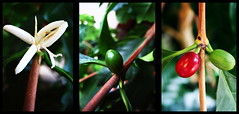
Originally uploaded by asteri design.
Terroir in a direct translation from French yields us simply 'earth' or 'land.' The basic interpretation of this is to say that a product has a distinct association with the land on which it was produced. Stating that the product is representative of it's origins would be the same as saying a product is expressing it's terroir. The term is difficult when trying to apply this to coffee or tea given the disagreements over the specific definition of this topic in wine.
The most simplistic definition of terroir I came across in my research was simply that terroir is a 'sense of place' that a product has. The terroir of a coffee is very broadly defined as the site or region influences that cumulatively give the coffee an attachment to it's origins. It is not simply the taste of earth but all the contributing factors therein that add to flavor. There are two ways the term terroir is approached in wine from which we draw parallels, but we first must have a better understanding of French culture and the approach they have to terroir in not just wine, but an array of products not limited to only the agricultural ones.
The French approach terroir as a philosophy in life. The love of dining and appreciation for local farmer's markets along with a focus on fresh ingredients are important to the French food culture. To the French, terroir seems to be applicable to any product, even clothing, which exemplifies the unique characteristics of a specific area. The traditions or methods of production can be added to the unique (soil, geography, climate) and physical(minerals, soil acidity, etc.) characters of that producing region in describing the product's terroir.
Much like Champagne is only truly a Champagne if produced in the Champagne region of France, this is the predominant view of terroir. The attitude is to preserve this uniqueness where in some cases it may not be viewed as desirable. In France it appears that saying something has terroir is to say that it represents where it was produced well.
The French focus is very much based on the importance of where it was grown over what varietal is used or the producer. The French love of terroir has worked to produce both quality and diversity in the French food, wine, and cheese market. In essence, the opposite to the mass produced commodity cultures you see in other countries.
There are two approaches to the concept terroir we must be aware of. The Old World approach and the New World approach.
The Old World approach is simply the previously mentioned French approach to terroir. To say, in wine specifically, that the flavor of the cup comes from the soil, geology, aspect, altitude, and other factors. An example is to draw a direct corollary between the flavor and the inputs from the soil. This would be to say that since this tastes of mineral and there is strong mineral content in the soil therefore it must be associated and therefore preserved. Each areas unique character is presented in the cup. It could be stated that Old World philosophy is more about restrictions placed on the product to achieve a specific representative quality much like AOC. In essence, the French label would focus on the growing region over the varietal or producer. For example, the French would say it is not a Pinot Noir produced in Burgundy but rather it is a Burgundy that happens to be made of Pino Noir.
New World philosophy seems predominantly based on viewing all the inputs as part of quality. They aim to use the terroir of the region to achieve a product they deem more quality. This is to say, they break down their lots into similar producing groups and attempt to achieve something of greater ripeness and evenness. Terroir is in essence an approach to quality in where defined standards are not traditional defined for the producing regions. The focus leans on the varietal used and not so much on the region. A means to an end if you will, where preservation of the traditions is not such a defining factor.
Applying terroir to coffee is very difficult to understand and this is why I have undertaken this project. Since the term is being thrown around a lot these days in the coffee cognesceti(as one roaster put's it), I feel it's time to begin thinking about this and research it more. Once we can begin to comprehend the term terroir, you begin to see how it is applicable in quality coffee. Silas believes the closest approach in Tea is that of Biodynamic teas, but that's an article for him to write.
Now, when someone speaks about the terroir of this coffee, you will understand what they are saying. Next time you are at your local roaster and they say, 'This is an exemplary Kenya, very expressive of what a good Kenya coffee should be!' Once tasting it, to agree your response could be, 'Yes, I see the terroir in that coffee!'
Subscribe to:
Comments (Atom)