Featured Post

There and back again

My last few posts have covered a lot of ground on the early years and more recent events, but there's a messy middle. I could start this...

Showing posts with label tea leaf. Show all posts

Monday, November 06, 2006

Tea: Judging Leaf Appearance


Photos by Ben Kaminsky


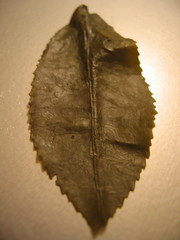
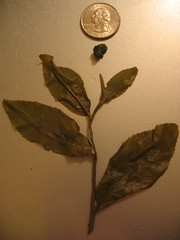
Left: a photo of a single unfurled leaf. Right: A quarter next to a rolled/unbrewed tea pearl with a brewed unfurled intact leaf/stem underneath.

Leaf appearance is a critical observation when judging the quality of a tea. Just like green coffee to a certain extent, you can judge the quality and the degree of precision in processing just by looking at the leaf. In China and Taiwan, the teas are sometimes named after their dried leaf appearance. In many cases, the leaf appearance cannot tell you exactly what kind of flavor it has, but it can certainly tell you all about the processing, and from knowledge of the processing you should be able to tell where the flavor is coming from. According to the Tea Research and Extension station in Yangmei Taiwan, “As a matter of fact, it is a good quality tea, as long as it looks good.” The idea behind this theory is that the people who are judging the tea train themselves to detect flaws in appearance that parallel those in taste.
When judging a tea by leaf appearance, one must look for several things. In the dry leaf, consistency, degree of oxidation, and roast or firing is evident. Also the skill with which the tea was handled and sorted is evident by the shape and consistency in size. The post steeped leaf can tell you how consistant the grading was and reveal flaws in the oxidation.

For example, things I look for in a Semi-ball type Poachong tea (the tea in the photo) are consistency in size, shape and color. The color tells you how heavy the oxidation and roast are. Size and shape tell you how well sorted the tea was, and also how the leaves were manipulated in the processing. In the wet leaf(after it is steeped), I look for evenness of oxidation, color, and how intact the leaf structure remains. A good semi-ball paochong should have very few broken particles when brewed and for the most part, the leaves should stay intact through the duration of the steepings. If the oolong leaf shows too much brown, this is a sign of too much oxidation and is contributing to the bitterness and astringency of the tea.
Judging what a tea should look like is different with each tea, and should be judged according to what the tea manufacturer was trying to get. In the end, cupping a tea's taste is the deciding factor, but leaf appearance helps explain how and why the tea tastes a certain way.


-Silas


Also see:

Tea: Processing

Cupping high grade taiwanese teas

Saturday, October 21, 2006

San Francisco Tea summary

I got back a few days ago, and I am still starry eyed from Bay Area’s essence. The Tea culture and the whole gourmet culture in general seems to be living proof that flavor can exist in a true and accessible fashion. A friend told me that there are about 100 bakeries in the city for San Francisco alone. There are some wonderful food experiences to be had in the area, as Andrew showed us. There are many tea houses of various quality and feel. A few of the more well known ones are Imperial Tea Court, Far Leaves and Samovar. To the best of my knowledge Imperial Tea Court and Far Leaves both source tea directly from estates in China. Another well know tea house is the Celadon Tea Room. They are renowned for their quality and freshness. Unfortunately, I missed my chance to go there because they are currently switching locations.


The Tea Culture in the San Francisco Bay Area is one that is entirely its own. Tea is much more a part of daily life and culinary experience than it is in Boston. This is obviously because of the strong Chinese and Japanese influence. Seeing Tea Houses ranging from good to simple doing well gives me hope for what Tea in the United States could become. As the culinary culture and focus on quality in what we eat and drink continues to grow, it is nice to see a few people paying attention to Tea. I only hope that this culture will continue to grow and the quality will improve. I hope also to see more focus on the flavor of tea as opposed to the conscious altering effects and social aspect of tea.


Lots of inspiration to keep tasting, and a desire to figure out what they put in their water was found in California.


-Silas

Monday, October 02, 2006

Tea Processing

Jaime has been talking a lot lately about the processing involved with coffee. It is interesting to apply this to Tea. Essentially when you roast coffee, you are bringing out the flavor; making it palatable. When you get to a certain point however, you start to kill the flavors by bringing the oils to the surface and scorching them. When you do this with a very flavorful coffee you are simply scorching the flavor, but when you do this with a less flavorful coffee you create a taste with the roast, simply because the bean has little inherent flavor.


Now the question I am posing in regards to tea is this: Does processing a tea, whether withering, oxidation, or firing, impart bad flavors, take away flavors, or add additional pleasant flavors without killing the flavors inherent in the tea leaf? Is it only certain processes such as heavy firing that impart or take away flavors in an extreme way? Do they shorten the life of the tea? Obviously the flavor is heavily affected by the processing and the degree to which it is taken, but at what point are you taking away from the flavor or manipulating it to a point where it has become less desirable? This is a hard question to answer, because there are so many different tastes and opinions on what tastes good. This is a way in which tea is different than coffee. Tea is steeped in so much tradition and ages of thought, that it is hard to say exactly what is good and bad from an objective stand point. When you take an opinion however, you could be simply ruling out a whole different world of taste different than yours. If you processed all the different varietals from the different places that fine quality tea is grown into white tea, would get the “true flavor” of the tea leaf, or would you just get a single expression of that tea?


Processing tea is an art and a science, as is coffee roasting, so is it my job as a taster to judge and simply express my opinion and expression by selecting teas that I like? Is my job to choose teas based on the criteria for that single type of tea? As a tea server is my job to serve tea in a way I think is correct or is my job to serve tea as a way of expressing the taste of the person to whom I am serving?


I think the key to understanding the flavor in tea, is what type of processing is done as opposed to how much is done. The taste of green tea is dependent on the way it is processed, but also on the varietal used. The main difference in taste regarding tea processing can be highlighted in the difference between Japanese and Chinese green tea. The Longjing green tea is the same varietal as the green tea in Japan, but they are processed very differently. Longjing is pan fired; whereas Japanese greens are typically steamed. Japanese green teas are usually very fresh, grassy, and sometimes sweet, whereas Longjing is more fruity, nutty and a much smoother flavor overall.


The best teas that I have ever tried are Oolongs. They are processed just enough to bring out the flavor without changing it too drastically. Oolongs are very specific and often complicated in processing. The truth though is that white, green, yellow, and Oolong teas all have their specific tastes and are all good in their own right. Black and Pu-erh teas usually have their fair share of flaws because they are processed so heavily. Because of this they have created a certain taste based on their flaw, much like coffee that is too darkly roasted or coffee that is fermented in processing the green bean.


-Silas

Monday, September 18, 2006

Profile: Silas Moulton aka 'the Tea Cupper'

Silas formerly was a purchasor for whole foods and also does cuppings with Mark @ MEM teas. Silas currently toils away at Peet's until something better comes along. Silas met up with us shortly after the Globe article hit and has been the most enthusiatic group member. He intially sought me out because he couldn't believe there was a good barista in Boston(his own words there). Silas will begin participating on the blog a bit to touch up his writing skills for his tea blog... I'm thinking... Terroirist tea blog! -Jaime

So a month or so after I met Jaime, I got an invite to taste some coffees with him and "some friends". To be honest, I thought his coffee tasting friends might be old men with mustaches and crazy stories about cupping kenyas in the glory days, when coffee wasn't so complicated. Well, It just so happens, we are all fairly young and none of us really care for facial hair. So after getting off work, smelling like Peet's dark roast, I went to meet up with Jaime, Judson and Ben. Ben was having issues with his tricked out home machine after messing with it too much, so we headed over to Asim's to pull some coffee shots. On the way Ben explained the difference between a chow hound and a foodie and of course Jamie was practically coming to tears of joy over the thought of having tegu coffee shots. They had been hoping earlier to pull some coffee shots on Ben's machine but they couldn't get it working. By now they were anxious for the coffee they had been waiting for all day and I was still curious what the hell these coffee shots were gonna be like. So when we get to Asim's place, we come to find out his machine isn't working either. This kick-ass, awesome $8000 espresso machine just couldn't get enough pressure. So Ben and Asim start taking the thing apart and trying to figure out what was wrong. They found out the thing wasn't building enough pressure cuz there was scale build up. Ben asked Asim where his cafiza was and Asim said he didn't know what it was. So now Ben was scolding Asim and just pissed that Asim doesn't know what cafiza is. They never ended up getting it working, and Asim had other plans. So the whole walk back to the T, Ben was ranting about how Asim didn't clean his 8000 dollar machine. I thought he was crazy cuz he had been practically yelling at Asim about it. We finally just went back to Simons and pulled some shots there. Then I tasted the Terroir yirg (2005) coffee shot..... and I was hooked!!

Well it turns out Ben is a pretty cool guy and Asim should just clean his machine. Now my mouth waters at the mention of coffee shot. We taste coffee pretty often now and I am known as "The Youth Project" or "Silas the Tea Cupper". I think I would prefer Flavor Cupper though...


Silas (flavor cupper)