This is one problem this industry really needs to get in gear on. We have this muddled idea of fresh ending at fresh roasted. Even the most transparent and progressive roasters are a bit vague on how far coffees are from harvest and that presents a crossroads for our industry.
When I think of fresh, there are four parameters: harvest, roast, grind, brew.
Harvest fresh being within 3-4 months off milling from parchment state or progressively packed in 'non-jute' to preserve that fresh flavor profile. From 4-7 months off harvest, coffees will be fine but aromas will already begin to diminish. 6 months and on, you are pushing how well the coffee can hold up and the acidity will diminish or turn rancid. Forget the soft coffees from places like Brasil or Colombia, they will be long gone by then. Wood, paper, lacking aroma... Do I really need to explain this again?
Roast freshness is the boutique industry(the online cognoscenti and niche roaters) standard. This seems to be the only way most 'Specialty' roasters distinguish themselves from the major chains. While most aggregate to the 2 week mark, a handful put best by dates going as far as six months out. You can almost guarantee these roasters have a market at a Whole Foods type grocer where turnover is hard to control. No roast date though, no idea of freshness.
Grind is a shop to shop issue. While more and more shops are grinding fresh or on demand, a lot of shops are still using the auto feature and filling hoppers or pre grinding drip brew. Whether the blades are serviced or sharp is another issue. As a home user, unless you absolutely cannot afford a grinder, there is no excuse for pre grinding coffee. Think of it this way: The bean is the final package and once it's open, all the flavors can escape.
Brewing fresh is a classic pitch that goes way back. Everyone has experienced the poor flavor of a pot that sat too long.
How important are all of these factors really? Do the customers care?
In the common market place, probably not. When you are asked to justify paying a bit extra for a shot or you are requested to splurge a bit at a cafe, yes. Not every shop in every market place can make these points matter but if one boutique roaster jumps in the deep end on all these points, it's likely many others will follow. Think about what that would mean for the purists among us wishing to really treat certain coffees like high end teas or begin to glimpse the wine model of labeling and marketing. A few bits and pieces to chew on while you think about what goes in your cup.

Showing posts with label green coffee. Show all posts
Showing posts with label green coffee. Show all posts
Wednesday, June 25, 2008
Monday, June 16, 2008
Herbs and veggies...
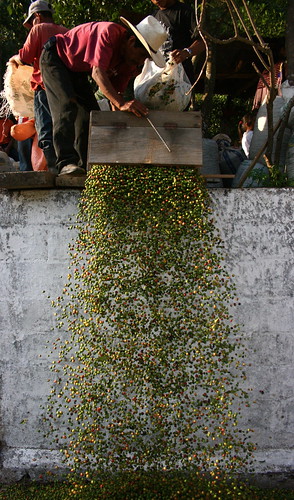
The vegetal taste in coffee seems to come from two main sources. Neither of which should be considered desirable.
One is the under ripe coffee cherry that adds a vegetal or herbacious note. You know your stuff when you can pick out the under ripes in a batch of unroasted coffee. The hemp descriptions of Sumatras and coffees like Chiapas come to me as more of a high under ripe percentage than true origin character. Under ripe are dulling so in a good roast, the sweetness is severely diminished by these buggers.
The other source is often a very common roast error known as roasting raw. This grassy astringency doesn't always become evident until the coffee is allowed to rest a few days and settle. Roasting raw is defined in the cup by a grassy smell identical to that of steamed green coffee and a punchy acidity that can turn weaker stomaches. It is often the hollow flavors and strong acidity that make this easy to identify as what we jokingly call 'green'.
Roasting raw is excessively common and can hide other problems in the cup while giving the fleeting impression of sweetness. The joke is that roasting raw can hide the age in a coffee and cover over a lack of character in some less stellar coffees where fixing the profile would make the coffees look decidedly poor. The cup will be initially sweet but eventually become hollow, have quickly fading flavors post roast, prove difficult in consistent brewing as a bag ages, and just unpleasant difficult to control acidity.

Monday, April 21, 2008
A Wee Bit Of Coffee
I just received an email entitled 'Update on your Guatemalan vac sealed coffees' and it made me smile. An update on that sometime later.
You'd be surprised how 'not like we think it is' the whole coffee exporting system is. There are fantastic coffees that just never make it to the tiny percentile of specialty roasters looking for it. Part of it is the simple fact they are unaware of us and our market. If they were somehow more aware of our tiny segment's demands, it would open a lot more doors for great coffees to reach our market.
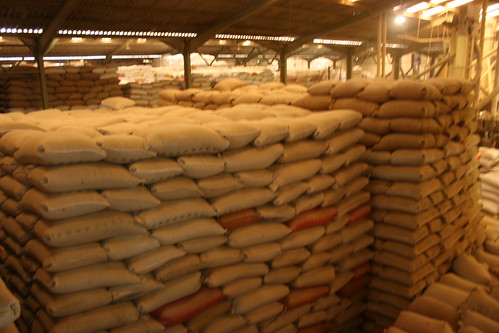
Somewhere in a stack like this is an amazing coffee or two.... or three...
Sunday, September 16, 2007
The Green Monstah

This post is for Nate, Snoz, and the Fettered by Secrecy Roasting Society (FSRS).
At my last time on bar, I had no real idea how important each phase of roasting was besides an understanding that it was hard because even the best struggled with it. I knew that sometimes the roasts were ashy, sometimes they were flat, and sometimes bright as there was a lot of variance batch to batch. Each week, it was a new experience and a test of patience. How can you raise the bar if the base is shifting?
After struggling for months to get evenly dried sample roasts while working the wettest/highest grown/most expensive green we could find, I have a few thoughts to offer. I now have suffered enough to realize that there are several layers of difficulty in roasting that the majority of people aren't always able to piece together. This site isn't a roasting how-to so let me give you a few things to chew on and think about for yourself instead of spoon feeding you something. Let's play myth buster for a moment.
Myth Number One: Light roasts are grassy, you have to roast darker to avoid this.
Truth: Light roasts that are dried properly will not be grassy. If you don't know what that means, it's time to do some research.
Myth Number Two: You have to slow down.
Truth: Yes and no or rather a maybe. Some people slow down and bake which does nothing positive but does mask the hot cup character a lot without fixing the real problem. Since each roasting setup is different, you figure it out for yourself.
I am theorizing that most of the major errors I am seeing in commercial roasts appear to be a product of improper drying either inefficient or uneven. If you can't get the head right, what good is finessing the tail? The pretty labels sure don't help and the barista can't change a thing.
What does 'bakey' taste like? What does 'green' taste like? Got something to chew on now, eh?
Friday, May 11, 2007
Seasonal coffee and preserving quality.
Coffee is an agricultural product and due to the multitude of growing regions throughout the world, it has multiple harvest dates through the year. The question I ponder today: when is coffee 'in season?'
I glanced at a forum post by Geoff Watts of Intelligentsia where he briefly touched on the facts that coffees, especially high grade coffees can degrade quickly.
"...coffees that campaign on a platform of delicate floral or fruit notes and seductive aromatics usually have a much more limited time frame within which to impress. Those are the first things to go when Chronos comes knocking, and are sitting on the beach getting a suntan long before any hint of woodiness or paper shows up. Another thing to consider is the original quality level of the coffee. Like Jimmy says, the harder they come they harder they fall. A coffee that earns a 94 in May might be closer to 87 by December, whereas one that starts at 82 might only slide to 79 in the same time frame. It's like the supermodel/beauty queen syndrome--most of these models/actresses are in their teens and twenties. Forty is geriatric by those industry standards, whereas your average person can still be considered quite attractive and vital at that age." Geoff
I know some people will disagree with that. Still others will agree then point out coffee being a seasonal crop which must be served 'in season.' Then there are others who are pushing that we simply abandon jute bags and do much more to preserve great coffees that believe the lifespan of a great coffee is much shorter.
I count myself as the latter. A sample of green for our green storage project that was open has already faded and lost considerable color and aroma. My initial fear is that our home style vac setup and freezing method are only able to slow age rather than stop any significant amount of aging.
The argument that irritates me enough to write is simply the 'seasonality of coffee' argument. Coffee is produced around seasons but I wonder if it is ever really in season. Simply put, we often get the coffees months after harvest, when are we ever really drinking something that is in season? Maybe the 'in' season is 3-6 months after harvest, after the coffee has sat in jute bags on docks or in transport on ships or over land for several months before we cup it.
It takes a series of steps to notice age in a coffee. You first have to be exposed to 'fresher' coffees that are very close to harvest and cup them regularly. This largely depends on sampling coffees from a roaster who air shipped a coffee or vac sealed it at origin or simply carrying back some high grade green coffee from origin. You must then roast in a manner that you would notice the floral and fruit slipping away and turning into woody notes aka 'the generic stale coffee taste.' You would also then have to value that fruit and floral aroma as a key component of the cup to value it at the same time devaluing the woodiness of age. Many who value body over fruit and floral would simply never roast in such a manner as to notice the fruit. The wild cup lovers on the other hand are simply not working with coffees upon which it makes a big difference either way.
While I quote Geoff, I think he is one of the people who could use his influence to push for those changes in transport and bagging for many of the farms he works directly with as well as in the industry overall. The problem is, it comes down to a definition of quality. A balance of what is acceptable financially vs an ideal. Acknowledging a problem and actually doing something about it are two different things.
How do you really define quality in coffee?
As Simon mentions to us often, it's the total package when you talk about quality. As a North American industry, we always chest thump about quality but it comes down to the entire product from seed to cup and preserving that quality... It's not simply the barista skills, equipment mods, and 'artisan' roasting. As Edwin often points out, coffee is a product in which we strive to preserve value along the way. We cannot intrinsically add value, we can only preserve what was in the 'finished' product at the farm.
Preserve quality. It's an interesting thought.
I glanced at a forum post by Geoff Watts of Intelligentsia where he briefly touched on the facts that coffees, especially high grade coffees can degrade quickly.
"...coffees that campaign on a platform of delicate floral or fruit notes and seductive aromatics usually have a much more limited time frame within which to impress. Those are the first things to go when Chronos comes knocking, and are sitting on the beach getting a suntan long before any hint of woodiness or paper shows up. Another thing to consider is the original quality level of the coffee. Like Jimmy says, the harder they come they harder they fall. A coffee that earns a 94 in May might be closer to 87 by December, whereas one that starts at 82 might only slide to 79 in the same time frame. It's like the supermodel/beauty queen syndrome--most of these models/actresses are in their teens and twenties. Forty is geriatric by those industry standards, whereas your average person can still be considered quite attractive and vital at that age." Geoff
I know some people will disagree with that. Still others will agree then point out coffee being a seasonal crop which must be served 'in season.' Then there are others who are pushing that we simply abandon jute bags and do much more to preserve great coffees that believe the lifespan of a great coffee is much shorter.
I count myself as the latter. A sample of green for our green storage project that was open has already faded and lost considerable color and aroma. My initial fear is that our home style vac setup and freezing method are only able to slow age rather than stop any significant amount of aging.
The argument that irritates me enough to write is simply the 'seasonality of coffee' argument. Coffee is produced around seasons but I wonder if it is ever really in season. Simply put, we often get the coffees months after harvest, when are we ever really drinking something that is in season? Maybe the 'in' season is 3-6 months after harvest, after the coffee has sat in jute bags on docks or in transport on ships or over land for several months before we cup it.
It takes a series of steps to notice age in a coffee. You first have to be exposed to 'fresher' coffees that are very close to harvest and cup them regularly. This largely depends on sampling coffees from a roaster who air shipped a coffee or vac sealed it at origin or simply carrying back some high grade green coffee from origin. You must then roast in a manner that you would notice the floral and fruit slipping away and turning into woody notes aka 'the generic stale coffee taste.' You would also then have to value that fruit and floral aroma as a key component of the cup to value it at the same time devaluing the woodiness of age. Many who value body over fruit and floral would simply never roast in such a manner as to notice the fruit. The wild cup lovers on the other hand are simply not working with coffees upon which it makes a big difference either way.
While I quote Geoff, I think he is one of the people who could use his influence to push for those changes in transport and bagging for many of the farms he works directly with as well as in the industry overall. The problem is, it comes down to a definition of quality. A balance of what is acceptable financially vs an ideal. Acknowledging a problem and actually doing something about it are two different things.
How do you really define quality in coffee?
As Simon mentions to us often, it's the total package when you talk about quality. As a North American industry, we always chest thump about quality but it comes down to the entire product from seed to cup and preserving that quality... It's not simply the barista skills, equipment mods, and 'artisan' roasting. As Edwin often points out, coffee is a product in which we strive to preserve value along the way. We cannot intrinsically add value, we can only preserve what was in the 'finished' product at the farm.
Preserve quality. It's an interesting thought.
Wednesday, April 11, 2007
Cupping coffee and the stinky bean
Stinkers: Stinker beans are generally caused as a result of over-fermentation, and due to improper cleaning of fermentation tanks and washing channels. Beans adhering to the pulper vats, if not cleaned meticulously, become stinkers. Stinker beans, when crushed or cut, emanate a very unpleasant odor. They taint the liquor, producing an unpleasant taste in the cup, and give a flavor described as 'over-fermented', 'unclean' or even 'foul'. One or two stinker beans can contaminate and spoil a whole batch of coffee. See also 'Discoloured', under 'Defects – Appearance / Coloration', above. - coffee-ota.org
There are times when coffee is fun and there are times when it is a lot of work. Cupping through slight roast variances from one single coffee roasted several times that when charted out look almost identical is definitely work.
I ran across this one thing that was just disgusting. A stinky bean (or two). Out of a dozen roasts and multiple bags, this showed up in two cups only.
Dry aroma, Skunk. Wet aroma like body odor. Taste was like 'someone brewed the coffee with toenail clippings.' Completely disgusting and foul. Out of six cups, two had this and I suspect it was because they were ground one after another.
I have never really cupped this before and yet this was so distinct in those two cups alone that it led me to realize why it is so essential to cup 3-6 cups of every coffee evaluated on a table.
Ouch!
There are times when coffee is fun and there are times when it is a lot of work. Cupping through slight roast variances from one single coffee roasted several times that when charted out look almost identical is definitely work.
I ran across this one thing that was just disgusting. A stinky bean (or two). Out of a dozen roasts and multiple bags, this showed up in two cups only.
Dry aroma, Skunk. Wet aroma like body odor. Taste was like 'someone brewed the coffee with toenail clippings.' Completely disgusting and foul. Out of six cups, two had this and I suspect it was because they were ground one after another.
I have never really cupped this before and yet this was so distinct in those two cups alone that it led me to realize why it is so essential to cup 3-6 cups of every coffee evaluated on a table.
Ouch!
Friday, March 09, 2007
The Green Storage Project...
Aaron, Eddie and I had a long set of email discussions leading to what we are calling the green coffee storage project. It is a collaboration among people we respect to effectively explore what happens to coffee in normal storage and estimate what options are available to a roaster on a budget to keep green at optimal quality until the next crop and possibly beyond.
The key is not to break new ground but to establish data and facts in a project that is repeatable for most any home user or small budget roaster. A lot of opinions have been offered and we felt it was time to do the research instead. This project is about exploration and transparency rather than obtaining proprietary knowledge.
Goal: To determine the necessity for better green transport and packaging standards. To evaluate and graph green age. To summarize the results and then conclude how to slow or prevent coffee flavor/aroma deterioration due to green age.
To determine measures to preserve new crop taste through the entire usage of a coffee.
Key materials:
-Green Coffee(Finca Vista Hermosa Michicoy)
-Vacuum packing and freezing materials available on a reasonable budget
Key Test Components:
Set 1: Coffee stored traditionally at a warehouse; shipped from Guatemala via standard means 2-3 months from harvest.
Set 2: Vacuum sealed coffees stored by the roaster; expedited from Guatemala weeks after harvest/milling.
Set 3: Vacuum sealed coffees frozen at 0-20C by the roaster; expedited from Guatemala weeks after harvest/milling.
The Setup:
Four groups will each have sets of samples provided to them.
At intervals over a two year period, the samples of regular green, vacuum sealed and frozen will be opened and roasted against each other. It will be up to each group to note or identify any changes or differences in each coffee that they observe and share these notes with the other groups.
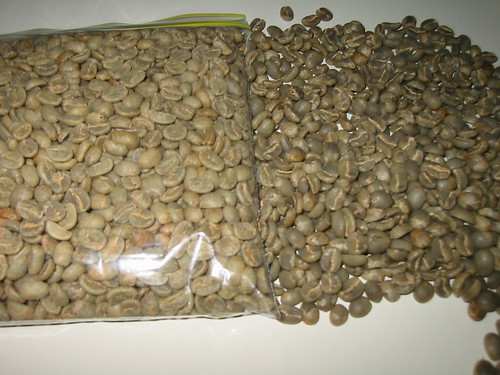
It was necessary to find respectable roasters who could look at the project from a pure quality standpoint and lend valuable notes on perceivable changes(if any) that existed in each set.
We appreciate Steve and Miguel joining Aaron and our crew in this venture. I hope they gain from this setup or at least enjoy the green in the process. I appreciate Edwin being so open to the idea and for his willingness to evaluate anything in the name of research or education. The goal is not to validate but simply for better understanding of green storage and the only expectation I have is that we will all come away with something from this project.
The project begins in the next few months and we at Barismo will be documenting bits and pieces of our personal experience when it is relevant.

The key is not to break new ground but to establish data and facts in a project that is repeatable for most any home user or small budget roaster. A lot of opinions have been offered and we felt it was time to do the research instead. This project is about exploration and transparency rather than obtaining proprietary knowledge.
Goal: To determine the necessity for better green transport and packaging standards. To evaluate and graph green age. To summarize the results and then conclude how to slow or prevent coffee flavor/aroma deterioration due to green age.
To determine measures to preserve new crop taste through the entire usage of a coffee.
Key materials:
-Green Coffee(Finca Vista Hermosa Michicoy)
-Vacuum packing and freezing materials available on a reasonable budget
Key Test Components:
Set 1: Coffee stored traditionally at a warehouse; shipped from Guatemala via standard means 2-3 months from harvest.
Set 2: Vacuum sealed coffees stored by the roaster; expedited from Guatemala weeks after harvest/milling.
Set 3: Vacuum sealed coffees frozen at 0-20C by the roaster; expedited from Guatemala weeks after harvest/milling.
The Setup:
Four groups will each have sets of samples provided to them.
At intervals over a two year period, the samples of regular green, vacuum sealed and frozen will be opened and roasted against each other. It will be up to each group to note or identify any changes or differences in each coffee that they observe and share these notes with the other groups.
It was necessary to find respectable roasters who could look at the project from a pure quality standpoint and lend valuable notes on perceivable changes(if any) that existed in each set.
We appreciate Steve and Miguel joining Aaron and our crew in this venture. I hope they gain from this setup or at least enjoy the green in the process. I appreciate Edwin being so open to the idea and for his willingness to evaluate anything in the name of research or education. The goal is not to validate but simply for better understanding of green storage and the only expectation I have is that we will all come away with something from this project.
The project begins in the next few months and we at Barismo will be documenting bits and pieces of our personal experience when it is relevant.
Subscribe to:
Comments (Atom)