On bars these days you find more and more usage of scales and thermometers but less and less interest in calibration. Like most things, there is a balance between dependence on something and willingness to check that what we depend on is accurate.
Here are a few things to calibrate and a few easy ways to calibrate them.
Scales: Some scales come with a gram weight which can be used for calibration. Alternatively, you can purchase a set of weights for calibration purposes. For your small scale that would be measuring amounts such as gram doses, a nickel is a good calibration tool. A nickel weighs 5g and once you have zeroed and tared your scale, you can simply place a nickel on it to see if it is accurate. A better way of calibrating a scale though is to measure the maximum capacity of the scale. If the scale maxes out at 5lb, finding something like a 5lb bag of sugar to measure the maximum of the scale. RTFM applies in all situations as many models of scales have calibration modes outlined in the manual.
It is also a good idea to make sure the scale you use for measuring small gram dose weights has a small enough resolution to be practical. Some scales have resolutions that vary as much as 5g as they are designed for weighing larger amounts, some are used for precision measurements of small amounts but need to be tared often or reset and tared between measurements.
Thermometers: Thermometers are easy to calibrate and hopefully everyone manual brewing coffee is measuring temperature. To calibrate a thermometer, simply fill a cup with mostly ice and a little bit of water allowing more than 80% of the probe to be submerged. Let the thermometer sit submerged for one minute and then observe the temperature. It should measure at 32f/0C. In conjunction, a measure of water at a rolling boil can give another data point. Placing the same probe into water at a rolling boil should give you a measuring point of 212f/100C unless you are at high elevation to which your boiling point may differ. (To verify espresso temperatures, we recommend getting a Scace and calibrating it the same way in both ice water and boiling to establish group head temperatures.)
Note: The usefulness of calibrating thermometers was most apparent for us. With our installation of two roasters (identical), we found the temperature probes (and spares) had a range of variance within 2 degrees. After identifying the offsets, we then programmed this into the displayed temperatures. When changing the temp probes, we would have to repeat the process of calibration.
Flow Meters: The traditional flow meter in an espresso machine is one of the most difficult items a professional barista can use. In many cases, we tend to abandon this because constant recalibration is needed. The reason being that in the dual boiler machines we use, the volumetric component isn't designed for precision and is placed in a position where hot water sits and scale buildup occurs. This creates many problems that makes it less than useful and often a hinderance. Recalibrating involves either a scale weight of the resulting shot (remember mL and grams are exchangeable) or a volumetric estimate with a 'shot glass.'
In the next year, a new type of flow meter will be introduced in coffee brewing that should not be confused with the volumetric controls on an espresso machine. The LuminaireCoffee volumetric controls are a generation ahead in that they function with more accuracy and are more useful in what they display. As opposed to the volumetric controls on an espresso machine, the LuminaireCoffee flow meter is in the cold water section and has less issues with buildup or hard water. It also is precision and digital which is best exemplified when using it in manual mode as it functions similar to a chronos display of time on a La Marzocco espresso machine. It simply displays total cumulative volume and time counts (and a dynamic flow in either ml/s or oz/min) as you are brewing. (In preset mode, it has cutoffs that can be set to stop the flow at either time or volume points.) Calibration of this is done at production but can also be done by measuring a specific volume of water in a specific time count with a calibrated scale. It makes brewing onto a scale to measure volume a bit superfluous (once calibration is verified). See Flow and Profiling posts for more relevant discussion.

Showing posts with label luminaire. Show all posts
Showing posts with label luminaire. Show all posts
Monday, November 29, 2010
Sunday, April 04, 2010
NERBC fallout
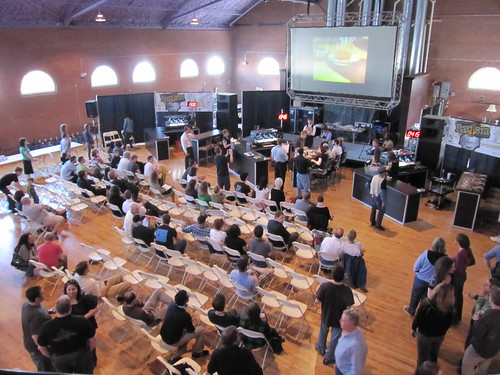
Post NERBC there was a bit of local press coverage from the Globe that really stayed neutral and got quotes from a lot of people there. The globe also did a sidebar piece on Luminaire as well. The Hario brew bar had two of their beta Lb-1 water delivery systems running continuous duty during the 3 days of the event. It was a great field test for their new concept and got them vital feedback from area barista/roasters. We are currently using one in shop right now and there is talk of one at Hi-Rise on Brattle St. as well as Pavement Coffee Bar when it opens. The brew bar and 4th machine were hugely successful and busy during the entire competition. Turnout during all three days was steady but the 4th machine and per cup bars were jam packed consistently.
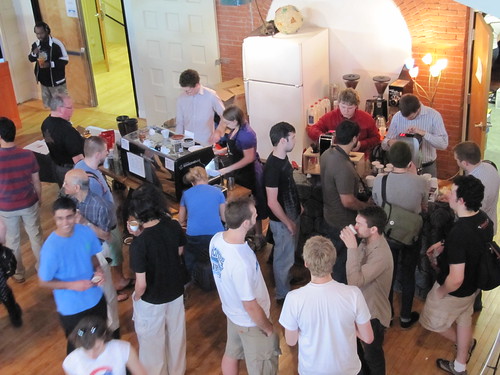
Anne and Neil of Tamp Tamp ran the espresso machine offering up drinks using a range of the sponsors and roasters who had contributed to the event. Likewise, the Hario and Luminaire per cup bar also rotated drip offerings by featuring two roasters at any one time changing throughout the day.
Both Somerville papers got in on the coverage. Between those articles, there were a few items that seemed a bit off, like '30,000 viewers online' and quoting how we at barismo had hosted competitions for years. We have organized and hosted many events over the years but this was our first barista competition.
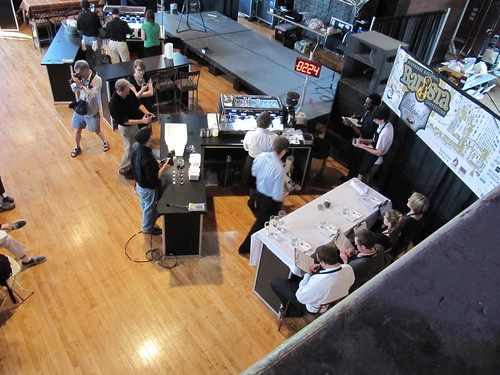
As for competitors, we had a very specific goal this year. We did not want anyone to compete from our company but Jamie Lynn decided it would be great for her after the positive experience she had last year supporting a competitor that I felt burned us later. Her goal was to get on stage and complete a routine that represented her and the shop she works at even if that meant taking hits on the score cards or doing things that don't fit in with the stage show. I am happy about how she handled the whole situation because her confidence as a barista has increased as well as the quality of her skill set. I look forward to her article in Barista magazine about the differing experiences. Her role was a specifically unique situation where she took that same attitude of training (not marketing) toward supporting the growth of the barista we sponsored by helping prep them with rule sheets and outlines. Ironic, if only because she fully intended to challenge the rules in her own routine.
In the weeks after competition, I have seen the confidence and attention put in by barista in the community and I have been really proud of the leap in training made by the barista who took the time to use the preparation aspect of competition for personal growth. I am particularly proud of both Alison and Nathaniel at Simon's who had previously had quite bad experiences at competition in the past. It took a lot of courage and dedication to get past those traumatic experiences and turn in good performances this year.
Congratulations to Danielle who took first and to all the other competitors who got up there and put themselves up for critique. We wish her good luck representing the NE even if she is a New Yorker now! It takes a lot to get on stage and handle that pressure. Congratulations to Matt from Matt's wood roasted coffee who took home the NE Regional Cup Taster's prize and is a nice guy to boot. A lot of area barista are looking forward to next year.

Sunday, January 31, 2010
The difficulties of per cup
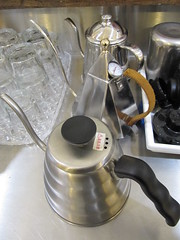
Articulated Water Delivery System: Simply put, the manual version of this concept is the hand pour kettle. Unlike a simple hot water boiling kettle, this version is designed with flow rate control in mind and the end user has an approximate but not precise control over the temperature. AWDS implies pouring where you want it at a flow rate you are trying to control. This is an important concept to think about when considering the usefulness and value of having control over flow. For the kettle though, this is an art form that takes an exceptionally long time to master. The difficult learning curve of balancing a kettle to get optimal flow presents a problem all it's own.
We can easily find other problems with nearly every option available for hot water delivery. They are inefficient, time consuming, and often impractical. So, let's take a moment to evaluate our options.
Table top boilers dispense water but you need to transfer that water to another container or bring the brew device to the water source. These boilers range from a large water tower down to a simple Zojirushi water boiler. These are always on and run continuously, tend to be very energy inefficient and the water is often stale.
Small hot water kettles are typically electric and boil water on demand. The main problems being that they need to have time to get up to boil and cannot handle any significant volume with speed. While fine for home use, they become increasingly impractical in cafe settings where any real volume is present.
The standalone brewer would be the so called 'per cup concept' that requires either a new brew method adoption or for the user to work with an entirely revised set of brew physics. The goal is often a tweaking of variables to attempt a quicker 'per cup.' This self contained brewer uses some new fancy way of brewing to set itself aside by trying to 'reinvent the wheel.' This kind of design concept is not only often expensive, it can easily have many flaws in design that may not show up until many users are out there testing it in real world scenarios well into sales and production. The real problem being that cup quality was often secondary to speed to balance the third item, cost.
So we acknowledge the problems and the question is, what's the solution?
We have an answer to that.
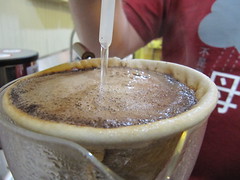 An AWDS that uses technology to provide flow controls and temperature controls would meet the need. It would not be a brewer by itself. Instead, it would provide hot water at precision controlled temperatures and adjustable flow rates through an articulated 'wand'. This would theoretically be the hot water delivery system that worked with all brew methods that could benefit from precision water temperatures and adjustable flow rate controls. All existing and widely used hand pour and general pour over methods would benefit from this system.
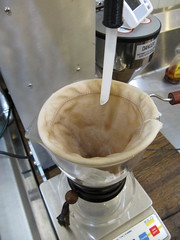 Instead of trying to create a new standalone brew system with new brew physics, a group of engineers have spent the last two years developing a hot water delivery system that functions as an AWDS. After an initial goal of stable temperatures and fixed flow rates, they have now tuned the device to respond to temperature and flow rate changes. That is unprecedented and as yet a largely unexplored avenue of brewing coffee outside of a few lab situations.
This would be an exteremly useful item for chemex lovers and melitta fans, but the real novel application seems to be when you tie in a product invented in 2006, the v60, it gets exciting. The v60 is designed in such a way that the flow rate of the water has an effect on the cup profile of the brew and adds another point of control. When used incorrectly or carelessly, it's a detriment to the resulting taste which creates a bit of a learning curve. The benefit of this control is that tied to a water delivery system with an articulated spout, dynamic temperature control, and adjustable flow rates, you have every variable in pour over brewing under control. Using technology to assist in brewing with an already familiar method speeds up the process to the point that brewing per cup now becomes very attainable in most cafe settings. Instead of reinventing the wheel, they came up with a design that works with all wheels making them more finely tuned and faster.
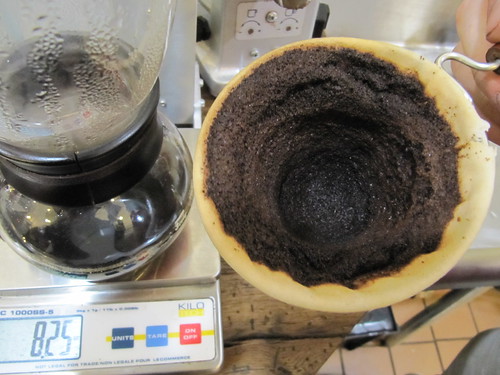
Brilliant and yet simple in it's vision. I am lucky to continue to be a beta tester and have input on this project while this concept goes into production and heads towards market. Lex and I are code naming this 'The Hippocrene Project' but you can find out more in the next few weeks on the Luminaire Bravo 1 water delivery system via: http://luminairecoffee.com/
Subscribe to:
Comments (Atom)