company - education - coffee
Showing posts with label how to. Show all posts

Tuesday, November 24, 2009

How to: The v60 1 cup 9 ounce method

v60-1: 1 cup setup
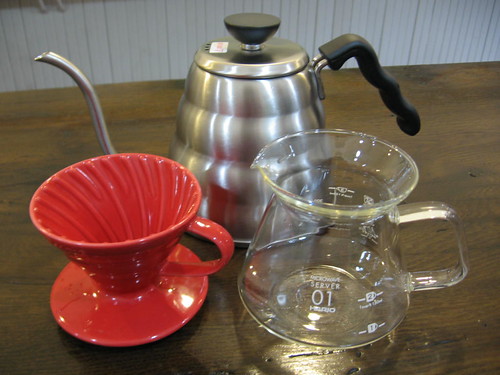
1 cup Range server, 1 cup v60, and Kettle


You will need:
Kettle
v60 1 cup
*1 cup range server
v60 filter (paper or cloth)
A gram/ounce scale
Thermometer (preferably digital)
Coffee and Grinder
Filtered hot water
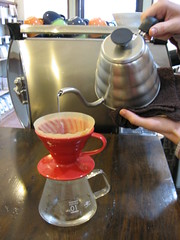


v60-2: Balancing the kettleThe following method is for a 9 ounce cup to approximate traditional US style drip coffees. With a slightly adjusted grind and slower speed of pour, a smaller resulting volume in the same amount of time can be brewed for more intense origin characters.

1. Rinse filters (cloth or paper) before each use with water off the boil. This will remove some unwanted tastes and warm the v60 itself. A rinse also helps hold the paper filters into place.

2. Use a cloth underneath the kettle when pouring for balance and to avoid burns. For best results with the Hario Kettle, a slight tilt on it's side can help control the slower pour speeds.
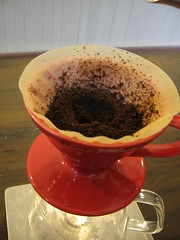
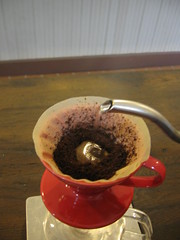
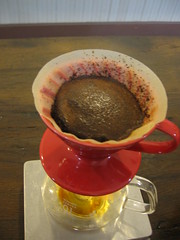

v60-4: Divet in groundsv60-5: Prewetv60-6 : Preinfusion bloom

3. After freshly grinding freshly roasted coffee, load 19g (+ or - to taste). Indent a small impression in the center of the grounds. It makes a difference for beginners in v60 to get an even pre-wet. It is extremely important to makes sure all the grounds are fully wet during this stage as dry areas will cause bubbling and channeling later in the brew.

4. Once water is ready off boil, allow it to cool to desired temperature (88C-92C OR 190F to 198F). Darker roasts will need lower temps while lighter roasts need higher temps as general rule.

5. Pour one ounce of water slowly into the center of the ground coffee then continue with deliberate circles outward until all grounds are wet. This should take a total of 10 seconds to completely wet the grounds.

6. Start your timer with a two minute count.

7. Allow the coffee to bloom for twenty seconds (+ OR - 10 seconds) after the last drip of the pre-wet pour. Some roasts will not bloom due to age or roast style, these make for difficult pour overs but can be rewarding with attention.
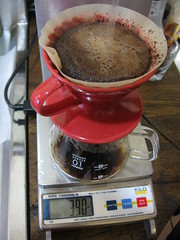
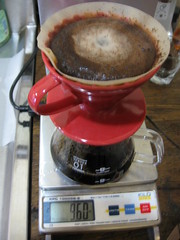
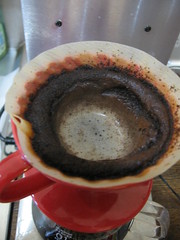
v60-8: Early pourv60-10: End pour for 1 cup @ 9ozv60- Final drawdown

8. Once the timer starts, allow the coffee to bloom and soak. In this example, we allowed it to sit for twenty seconds before pouring. The initial pour after pre-infusion is important because we want the grounds to unfurl evenly into a V shape as we slowly pour into the center. An errant or too fast pour can cause side channeling and it's best to avoid this. Pouring down the sides is also not recommended as this will agitate grounds and cause bitters in the brew. A reminder, this is not a pour and fill method so water that does not pass through the coffee will simply drain off quickly. The floating dome that forms an inch around the outside of the brew has an insular effect and it is not necessary to break this during the pour. In fact, results of washing the edges on the final pour have been very unpleasant.
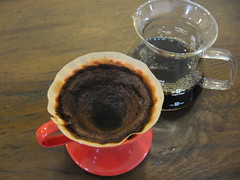
v60- Spent grinds9. For this method, a steady pour of nine ounces from the twenty second mark until there are thirty seconds left on a two minute count has worked best. If the grind is set correctly, the last few drips will happen at or just after the timer goes off. For a larger v60-02, we would add a minute to the total time and adjustments to grind/dose/pour.

10. The resultant grounds should be evenly distributed and symmetry isn't necessarily a bad thing! Take notes, make adjustments and record the effects of those changes. A method can always be tuned from it's starting point to personal tastes.

Get started on this with the pour over mini pro pack.

For brew guides and other methods visit our education section.

Sunday, September 21, 2008

The Syphon Primer Companion

Forward: With Syphon brewing becoming tragically hip lately, we decided to go back and do a comprehensive look at our development in this Simon Hsieh inspired methodology for the Hario TCA-2 and how it has expanded in our community.

We started getting deep into Syphon more than a year ago. It was when we had access to some of Simon Hsieh's coffee and were inspired to understand more that we became serious. We adopted his methods off his blog and began an exchange with him about coffee and brewing in general that has really shaped our current direction away from where our community was headed (see Clover) at the time. We quickly adapted as much as we could understand and began quantifying the methods. We spent time evaluating why each step was important in the brewing process and where could we go with it. We attempted a basic video that got solid feedback and that was the beginning of a series of steps focused around Syphon brewing and demos.

We did demos here in town for small groups, traveled out west for a friend's Jam, and shared the methodology with others who were interested. Which brought us back to the beginning when Simon Hsieh visited us in the US. Some hands on technique was applied and some extra movements were removed to simplify and refine our brewing method. A few autographed copies of his book for good measure and a Syphon demo event topped the visit.

Fast forward to the future and you see competing methods being posted on other sites and more discussion about this old school method but more to the point, three of the six USBC finalists use a version of our preferred method!

So as we are moving on to new subjects we decided to compile a comprehensive primer and updated video people can use based on our experience. This is especially relevant as we now have the TCA-2 for sale at the brick and mortar shop. Enjoy~


The Complete Syphon Primer

Barismo Syphon Primer Demo

Thursday, June 26, 2008

Mis-understood drip

Drip Coffee, photo by Ben Kaminksy

To many, drip coffee is the ugly blemish that they want to forget. I mean, no self-respecting "waver" will ever allow that dreadful Fetco compared side by side with Clover at their shops. The truth is, drip coffee accounts for quite a bit of business and is probably the most common method that home users (the normal kind, not your "geek" type that make up very small percentage of the market) utilize to prepare their daily coffee.

I have to admit that we too had our own bias against drip a while back. From our earlier experiences, the drip cup profile just did not have the intensity and flavor that a Syphon or Espresso profile possessed. It was not until we started to dabble in manual pour technique and have a better understanding of the roasting process that we finally understood the potential and power in drip coffee.

Just like ANY other coffee brewing techniques, when tuned with proper dose, temperature, time and roast, a cup of drip coffee can be just as flavorful, intense and satisfying as a vacpot cup. In fact, at a recent home gathering, a coffee drinking friend told me the cup of drip I prepared for him is nearly as intense and flavorful as a shot of espresso.

The following is my drip brewing technique. This method is based on the one presented in Simon Hsieh's book with my tweaks to tune for my machine/coffee/roasts.

The gears:
- Presto Scandinavian with modified shower head
- Mazzer Kony
- Melitta #4 filter - white (note 1)

Parameters:
- Use 10~14g per 6oz of water. Adjust if the cup is too intense for you...
- A fine grind (10~15 small notches from espresso on Mazzer SJ, 18~21 notches from true zero on Rocky).

Grind Setting, photo by Ben Kaminksy
Steps:
1. Fill the machine with approximately 8oz of water. Start the machine without coffee/filter in it. This preheats the machine.
2. Grind coffee while the machine pre-heats.
3. As soon as the machine is done pre-heating, place coffee in the basket, level the grinds (note 2), and start brewing immediately (before the machine cools down).
4. Turn the machine OFF after about 20 seconds. For me, this is about 3 "gurgles". The purpose of this is to pre-infuse the coffee and allow all the grinds to be saturated(bloom) before starting the remaining extraction. You will have to experiment with the timing of this cut-off - just pull the basket out to see if all the grinds are properly wet at various time.

Pre-infusion, photo by Ben Kaminksy

5. Turn the machine back on after 20 seconds of wait time(the end of pre-infusion).
6. Complete the brew within 3~4 minutes if possible. Play with the dose to find out the optimum capacity of your machine. For my Presto, the upper limit is at around the 5 cup mark.
7. Remove the carafe immediate after brewing and serve.

Spent ground, photo by Ben Kaminksy

That is it. With a little bit of care, this simple method can produce just as good of a cup as with most other brew methods!

Cup of Drip, photo by Ben Kaminksy

note 1: I like Melitta filters because the small holes in the paper seem to allow a bit more oil to pass thru; not as much as a cloth filter but is better than any paper filter I've used. To me, the natural/brown paper filters are quite foul and imparts a very strong brown paper bag taste to any liquid that passes thru. If you insist on using it, please rinse it with some hot water first to reduce as much of the off flavor as possible. And for those of you who just have to use a gold/metal filter, please be aware that your brew time will be altered due to the different flow rate. It will flow a bit faster than the paper filter and will most likely require a even finer grind setting to achieve the same dwell time (which puts even more sludge to the cup... hmmm... gritty...).

note 2: Simon advocates shaping the coffee mound in the basket to match that of the shower head - putting divots where the exit holes are located (imagine using the shower head to make an indention on the coffee mound). Since I have modified my shower head to have near full coverage, it does not make much of a difference for me. For those machines with limited water exit holes, try Simon's recommendation to see if it makes a difference.