We've mostly dug out and are looking to reopen Sunday morning. Living right around the corner means we are some of the first to be able to dig out. Expect normal Sunday hours. We hope you are able to dig out as well and drop by for a coffee.
Featured Post
There and back again
My last few posts have covered a lot of ground on the early years and more recent events, but there's a messy middle. I could start this...
Saturday, February 09, 2013
Wednesday, February 06, 2013
The value of transparency
A bag of coffee should answer the 3 W's: Who, what, and when?
Who produced this coffee? The land owner and the mill that had a hand in creating this product should be identified (when known). There must be as much information as is needed to begin to build a relevant understanding of the production chain in growing/picking/milling a coffee. Who is the starting point of a long chain of questions to ask about what makes a coffee unique.
What makes this coffee special? Elevation, processing at the farm/wet mill/dry mill, regional location, and special packaging of the unroasted coffee for transport. Things that can impart or change/preserve the flavor of a coffee add to the knowledge base a consumer builds over time of what they prefer while trying different coffees. Do I prefer bourbon or caturra more? Am I more interested in higher elevation coffees? The list goes on but how can you build those preferences without knowledge of them existing as a contributing factor to a coffee.
When was this coffee harvested/roasted? Knowing the crop year is a nice item but it's often too rare an addition. Knowing the roast date is one of the most basic and fundamental tenets of good coffee. The nicest production with the best terroir roasted to perfection will be wasted by staling. A clearly labeled and recent roast date is the first real indicator you will get your money's worth or have a chance at a better coffee experience.
"If coffee is truly to learn something from the wine model, it is that brand identity for farms (even in a blend) adds value for both the producers and their consumers."
Identity is a powerful thing. Prominently displaying the producer information gives the farm a brand with a sense of the components that go into creating the flavors of that coffee. This is so valuable that even larger roasters borrow this identity and sense of place by naming some of their large mill and co-op blends with farm style or estate-like sounding (although slightly misleading) names.
With single estate coffees, this process of identifying the producer and micro lot name is becoming more main stream every year. For espresso, it is clearly not the case as we are sliding backwards locally. (A recent cafe crawl of what are supposed to be top shops in town found that almost all not serving barismo were serving a blend with unknown -to the barista- components. Seeing great gear with talented barista precisely executing mediocre dark roasted blends was a let down. That disappointment inspired this post.) The long known secret with roasters is that you can mix together lesser quality components, roast it darker, and charge a better markup if the mystery inside is not revealed (as long as it says espresso on the bag). Identifying the constantly changing mix of coffees in a blend and having cafes/consumers look up the components could cause problems by revealing the secrets of the blend. Those secrets may not be glorious and the previous perception of a good deal could easily turn around with a little more delving into the ingredients. High end micro roasters working with estates are more likely to abandon the faceless blends identified with mass produced roasting outfits and more have been opting for complete transparency. If coffee is truly to learn something from the wine model, it is that brand identity for farms (even in a blend) adds value for both the producers and their consumers.
The basic question: Is the roaster proud enough of the product to show what's in it? Transparency is that affirmation. Labeling with confidence speaks to knowledge of the coffee and what makes it special. That, in turn, can infer there is knowledge of how to continue to make it better.
Tuesday, February 05, 2013
What local can do
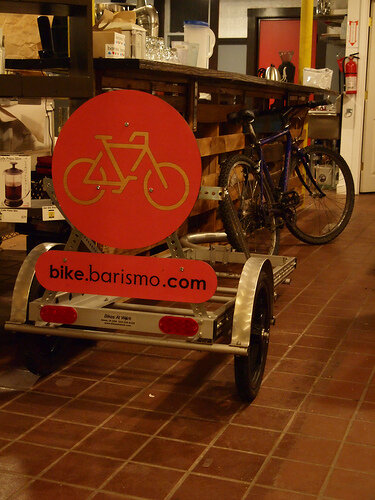
![]() |
| Follow this bike to good coffee |
Track it through bike.barismo.com where we are testing out using a foursquare script to locate where the freshest retail shows up. We are also updating our stops on twitter so that you can get yourself over there for some bags.
Relationship coffee delivered the same day it's roasted or the next morning is kind of a cool thing. Since fresh roast is such a key component to great coffee, we consider this a bit of a quality assurance project!
We're having fun with it and hope you can support this project by picking up a bag of coffee at one of our stops.
Wednesday, November 28, 2012
Ethiopian coffees are back!
Some of you may have noticed a decline in our Ethiopian coffee offerings over the last couple of years. Ethiopia is in fact one of the countries in our logo, so you would think we would pay extra attention to those coffees. While Ethiopians tend to be some of our favorite coffees, there are a few reasons why we have chosen to buy very few over the last couple of years.
The first, and biggest reason is the Homogenizing of Ethiopian coffee by the Ethiopian Coffee Exchange. The ECX separated coffee into regions as opposed to farms, and prohibited all direct farm-to-buyer sales (other than coops and ECX lots). What this did was cut off access to the tracking and sale of small excellent unblended lots and commoditize the uniqueness of these small lots into large lots of average specialty quality.
The second reason we avoided buying Ethiopians was the ‘C’ market price jump of 2 years ago. This made coffee that was normally in the mid $3 range cost over $5 in some cases. Coffee that is both more expensive and of lower quality is never a good combination. These factors made us put our resources and time into Central America.
The good news is both of these things are no longer issues. The quality and availability of farm direct Ethiopian coffee is now better than ever. We are seeing new regions like Western Ethiopia, Jimma, Kaffa, and new varieties (actually very old) like Abyssinia. Abyssinia is an old typica variety that was brought to Indonesia in the 1920’s. Expect to see a great increase in the number of offerings from Ethiopia roasted by us, and a greater range in flavor in those offerings than ever before. We have started you off with a classic Sidama that is bursting with florals, with a nice underlying meyer lemon and touch of berry. The sorting is exceptionally clean on this coffee so for once you shouldn’t have to worry about too many defects.
One interesting thing about this coffee is the fermentation. It is given a 72 hour soak for fermentation then vigorously agitated to remove the mucilage. Finally, the coffee is soaked overnight in clean water, washed, then dried on raised beds. This is the classic method in Sidama and Yirgacheffe but contrary to the way fermentation and drying is done in Central America. For example, at Hacienda Santa Rosa coffee is depulped then dry fermented for 48 hours then washed and dried on a concrete patio.
We wanted to explain some of the reasoning behind our buying decisions since washed Ethiopias are some of the most interesting coffees you can taste and we had all but phased them out. Enjoy the Deri Kochoha and look forward to even more really great Ethiopian coffees.
Sunday, October 14, 2012
barismo is moving
Many of you have seen the 'for rent' sign at our space recently and may have wondered what's going on? Long answer is we have been growing a lot the last few years and outpaced the size our current space could handle some time ago. We began looking a few years back into spaces for the roasting operation (which triggered finding the space dwelltime is now in). We decided to pull back given that expansion would have stretched us quite thin at that time.
When our current landlord at 169 Mass Ave came to us recently to tell us that the space a few doors down at 171 Mass Ave was opening up, we took a long hard look at what we could do there. It seemed like a perfect fit for us but a little more time had to pass for us to figure out how to handle the shift. A change of pace and a redesign began to seem like the perfect solution to years of cramped growth in our current space.
Recently, we fully committed to the move with a new approach and new floor plan. The space will be divided into two sections. A roasting section where all your coffees will be produced and bagged and a small coffee bar with seating (yes, you read it right).
The roasting and production area will have it's own cupping and training setup to work with our wholesale accounts. Our green buyer will have dedicated office hours to pass along information on coffees and help those working with our coffees get a leg up on new estates as they come in. We will even have some space free weekly where barista we work with can come by to sample coffees from other roasters on our setup. The space will allow us to function as a training lab to experiment while simultaneously working on quality control projects, the best of both worlds.
The coffee bar area is going to be a unique design given how much more space we have to work with. The main focus will be on our 'by the cup' service. We've been at the forefront of manual brews in our area and have no intention of slowing down. Expect a cart service for Syphons and a shift towards more cloth filter brews on bar. Our espresso bar will continue to be a simple offering list presented in a traditional format of limited sizes. We will add a few sweets and food items to the bar once we get fully operational and will function more like a regular cafe with our espresso service.
Expect us to begin moving in later this month and complete the move in November. We will post interruptions in bar service on the door and on twitter as soon as we know of them. We are looking forward to the new space and hope to see you there.
When our current landlord at 169 Mass Ave came to us recently to tell us that the space a few doors down at 171 Mass Ave was opening up, we took a long hard look at what we could do there. It seemed like a perfect fit for us but a little more time had to pass for us to figure out how to handle the shift. A change of pace and a redesign began to seem like the perfect solution to years of cramped growth in our current space.
Recently, we fully committed to the move with a new approach and new floor plan. The space will be divided into two sections. A roasting section where all your coffees will be produced and bagged and a small coffee bar with seating (yes, you read it right).
The roasting and production area will have it's own cupping and training setup to work with our wholesale accounts. Our green buyer will have dedicated office hours to pass along information on coffees and help those working with our coffees get a leg up on new estates as they come in. We will even have some space free weekly where barista we work with can come by to sample coffees from other roasters on our setup. The space will allow us to function as a training lab to experiment while simultaneously working on quality control projects, the best of both worlds.
The coffee bar area is going to be a unique design given how much more space we have to work with. The main focus will be on our 'by the cup' service. We've been at the forefront of manual brews in our area and have no intention of slowing down. Expect a cart service for Syphons and a shift towards more cloth filter brews on bar. Our espresso bar will continue to be a simple offering list presented in a traditional format of limited sizes. We will add a few sweets and food items to the bar once we get fully operational and will function more like a regular cafe with our espresso service.
Expect us to begin moving in later this month and complete the move in November. We will post interruptions in bar service on the door and on twitter as soon as we know of them. We are looking forward to the new space and hope to see you there.
Subscribe to:
Posts (Atom)