Featured Post

There and back again

My last few posts have covered a lot of ground on the early years and more recent events, but there's a messy middle. I could start this...

Tuesday, March 27, 2007

Upcoming Event: An Introduction to Coffee Cupping

Cupping

We here at barismo decided to put on a cupping event to explore various offerings from premiere roasters across the country. The event will be hosted at Simon's Coffee Shop in Cambridge and will be held on the evening of April 21st. Seating is limited, so if you're interested please contact me at events@barismo.com for further details.

Sunday, March 25, 2007

Don't blame the Barista!

The smell of rancid burnt coffee, the shot that pulls in 15 seconds... but it's not the barista who is really at fault here,is it? Sure it's easy to blame the person behind the counter for your bad cup of coffee but let's be realistic for a moment and take the long view.

When we look at all the quality inputs that go into a coffee from the seed to cup, there are a lot of points in the line that must be accounted for.

Yes, accountability is the key to production of any good product.

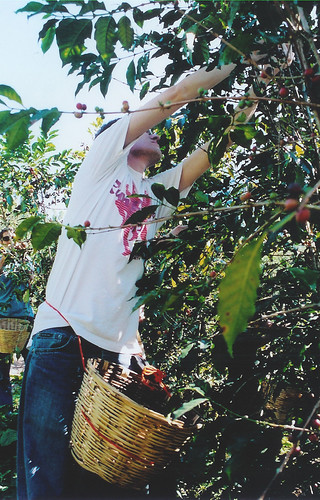
Pre-harvest, the terroir of the land and all climate inputs to the coffee are critical. Ideal rainfall, keeping away/treating pests and disease, and adequate shade are only a few of many issues the farmer faces in getting the crop to harvest. Once at harvest, care must be taken to pick the ripest cherries without damaging the tree and it's possible future growth. This means multiple passes over the harvest to get the ripest harvest possible. This is all based on if the weather permits.
Picking coffee takes more skill than you think

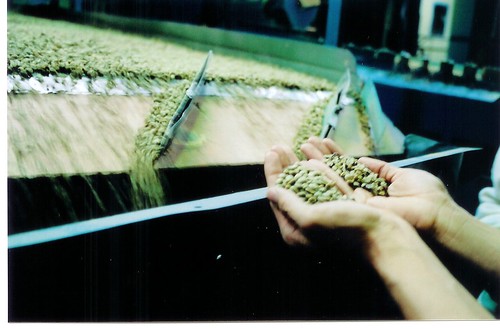
Assuming the crop is turning in a good harvest, the processing must be exceptional to clear away as many defects as possible. Under ripes, bug bitten, and all sorts of undesirables must be sorted out in either the milling phase, the processing method itself, or by hand.
sorting by vibration

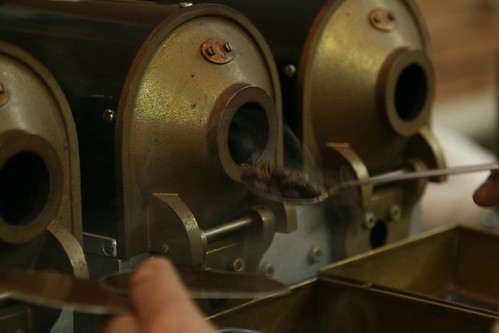
Now once this goes to market, the green buyer must find this pristine lot among many by identifying it with only a small sample to go on. Assuming the green buyer does identify the lot and arrange it's purchase, the lot can still be contaminated, age or otherwise change from the time the sample was taken to the time it arrives often months later.
sample roasting
Photo Courtesy of Jason Silberschlag

Once the roaster has the bean in their hands, they must begin identifying an ideal roast profile and begin to reproduce it consistently. If the roast is not somewhat consistent, it will not be easy to produce a consistent product in the cafe. The roaster must then deal with logistics and packaging to get the correct coffees in the correct bags and to the correct people.

This is something almost every business must deal with and mis-labeling bags or inaccurate shipments is an accountability problem in the system, not necessarily a coffee specific issue.

The next phase is the cafe owners/management who must provide adequate equipment which must be cleaned, serviced, and maintained well for the end product to resemble what the roaster is providing. I have visited very few cafes which simply have grinders that are up to date where the burrs are changed regularly much less a knowledge of the temperature of the brew, so this presents one of the biggest problems in production.
Sharing some barista notes
Photo Courtesy of Jorg and Corinna Scott

This is an issue where the cafe owner/management must work with knowledge often provided by the roaster to train staff and understand equipment maintenance and even adjust technique/parameters to get the most from the coffees. This is strictly an opinion, but great cafes are built on knowledge and one of the few legitimate sources of that knowledge and training should be the roaster. This is not often the case as many roasters have a fear or simply appear to not want to stir up trouble by suggesting improvements. This often shows up as a personnel issue where knowledgeable people with good communication skills are needed to get cafe owners on board with a quality program.

At the end of the line is the Barista. A low pay individual who is often left to their own devices with minimal training. Sadly, they are often left to the burden of selling a product they may not be proud to sell. To change this though, they must overcome management or push for changes when resistance may lie not only in management and with coworkers but at the Roasterie as well. A bit too much to ask from a Barista.

When you look at the bigger picture, it's hard to blame farmers who are simply responding to whatever we demand. It's also hard to focus simply on the Barista and put the entire weight of the process on their shoulders.

When you have a complaint about your coffee, consider leveling it at management or even better, call the roaster and discuss the account. Rather than focusing on the individual, we should focus on the organizations. Bringing attention to the company will create a need for training or change. While a barista is in no position to respond, the company can.

On the other hand, you could always look for another cup at another store in the future until you find a better coffee and vote with your wallet. The simple fact that we don't demand better or make our voice heard is part of the reason a good cup is hard to find.

When you do find a good Barista, tell the management and yes, please leave them a tip because good Barista are a good thing.

Saturday, March 24, 2007

Tipping the roast

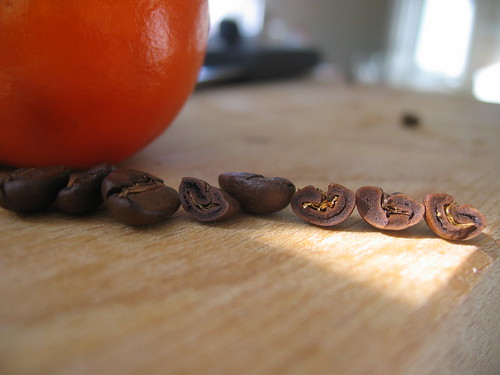
Tipping and scorching are roasting errors which lead to an uneven roast. You can read more about this topic in this brilliant article by Willem Boot.

Photography by Ben Kaminsky


A friend once addressed me saying that I surround myself with many people who don't scorch or tip and I began to see that as the norm. I didn't disagree but the truth is we have dealt with this particular subject for a long time to the point it is affectionately called the New Flava Roast or the 'single bean melange' in mockery.

The particular flavors that come from this are not enjoyable in the least. You have vinegar and ash in the same cup where I can honestly say it would take an odd palate to put wonderful descriptors to this one.


Photography by Ben Kaminsky


Interior scorching is identified by this layered coloration. You can have defined unevenness which will lead to a fuzzy taste profile and a murky cup. There are no layers or clarity in the cup and no distinct flavors. Often unpleasant and if you didn't take the time to crack open a bean and examine the interior, the outer coloration would look normal.

Pay attention to your roasts people!

Tuesday, March 20, 2007

'Lemony' Espresso


I had another shot of a 'lemony' espresso this morning. One I would normally refuse but it was free and I felt I could not refuse since it was my opinion that was sought. It was not painful, nor was it comparable in sweetness to our last espresso venture. In fact, it was kinda boring or you could say clean in the 'I don't mean' way. Not much aroma, very little creaminess and little viscosity. It was like a little lemon curd pastry in it's singular flavor component. It is not that I do not like a little lemon citrus in my espresso, it's just that I like somethng creamy and thicker for espresso. Once upon a time, Ben and I may have said this was a unique espresso but times have changed... a lot.

A nice Yirgacheffe with beautiful aromatics and a hint of lemon is nice. A Kenya, a Guat, or a Colombia with some lemon would be interesting. I love a good fruit character in a coffee but this shot was none of these.

It is not that a Brazil cannot be lemon but the question is should a classic washed Brazil in espresso be all lemon? OR maybe the question is, could I sell something like this with confidence and conviction?

Brazils can be boring but honestly, they make a much better base than your garden variety earthy spice characters often used as a base in espresso. When I think of Brazil though, I think vanilla, sarsaparilla, nut, cocoa, caramel, molasses... sure, but lemon, I am not sold on that. It's like trying to pull fruit out of something that isn't, for lack of a better term, fruity.

I don't know if lemon is really a big issue for me in an espresso I don't drink and would not serve but maybe that's not my point in writing today. I realized that this drink sparked a conversation.

You have to have perspective.

The best thing I ever did was consistently serve multiple espresso and varied roaster's coffees in one shop. When you only see one roaster's perspective, you lose your perspective. If all you ever really taste are your own coffees from one source, you will not have a greater understanding of other people's styles and the realm of possibilities that exist beyond what you are currently serving in a cafe. As a Barista, a shop owner, a consumer, and also at the roasterie, trying various styles leads to growth in palate and appreciation of what coffee can be.

I had a long debate about this with friends (Corinna and Jorg) in Guatemala. The greatest single thing you can do for yourself is to try everything and don't buy into the hype about anything. For all the Gurus and supposed Masters, there are a dozen others who scoot by under the radar doing amazing things without flashy egos or lengthy diatribes on why they are the best.

Sometimes, it's the guys who aren't selling themselves to their peers who are doing great things in their own shops. If I hadn't been guesting coffees, I never would have run across Andrew Barnett, Miguel Meza, or a whole other group of roasters out there doing respectable work. Heck, we may have even thumbed our nose at other great roasters simply because they didn't agree with what our current roaster is doing if it weren't for our guesting program.

Some podcaster once offered that a roaster is like the religion you choose, I would offer that roasters are like chefs and there are many to choose from with lots of perspectives on interpretation of the same ingredients. Sometimes, you can mix or match to what you perceive as their strong points, other times you let them lead you to a unique experience.

Coffee is an evolution and if you lock in too hard to one philosophy, there you will be and no further.

Point is, whether you were hooked into coffee by a chocolate ristretto or a lemony lungo, take the time to see what else is out there and give it a chance with an open mind and a curious palate. Don't listen to the pundits and try everything for youself because there are no standards and there is a unique new taste out there around every corner.

Friday, March 09, 2007

The Green Storage Project...

Aaron, Eddie and I had a long set of email discussions leading to what we are calling the green coffee storage project. It is a collaboration among people we respect to effectively explore what happens to coffee in normal storage and estimate what options are available to a roaster on a budget to keep green at optimal quality until the next crop and possibly beyond.

The key is not to break new ground but to establish data and facts in a project that is repeatable for most any home user or small budget roaster. A lot of opinions have been offered and we felt it was time to do the research instead. This project is about exploration and transparency rather than obtaining proprietary knowledge.


Goal: To determine the necessity for better green transport and packaging standards. To evaluate and graph green age. To summarize the results and then conclude how to slow or prevent coffee flavor/aroma deterioration due to green age.

To determine measures to preserve new crop taste through the entire usage of a coffee.

Key materials:
-Green Coffee(Finca Vista Hermosa Michicoy)
-Vacuum packing and freezing materials available on a reasonable budget

Key Test Components:
Set 1: Coffee stored traditionally at a warehouse; shipped from Guatemala via standard means 2-3 months from harvest.
Set 2: Vacuum sealed coffees stored by the roaster; expedited from Guatemala weeks after harvest/milling.
Set 3: Vacuum sealed coffees frozen at 0-20C by the roaster; expedited from Guatemala weeks after harvest/milling.

The Setup:
Four groups will each have sets of samples provided to them.
At intervals over a two year period, the samples of regular green, vacuum sealed and frozen will be opened and roasted against each other. It will be up to each group to note or identify any changes or differences in each coffee that they observe and share these notes with the other groups.

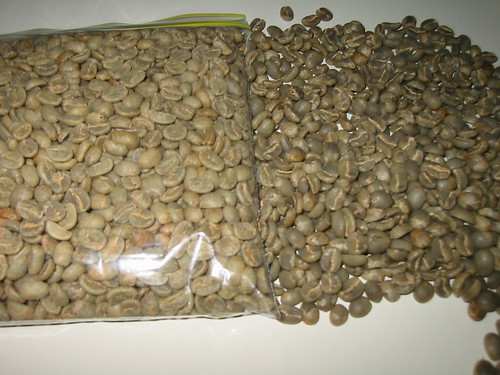
left Colombia S. Huila : Right FVH Michicoy


It was necessary to find respectable roasters who could look at the project from a pure quality standpoint and lend valuable notes on perceivable changes(if any) that existed in each set.

We appreciate Steve and Miguel joining Aaron and our crew in this venture. I hope they gain from this setup or at least enjoy the green in the process. I appreciate Edwin being so open to the idea and for his willingness to evaluate anything in the name of research or education. The goal is not to validate but simply for better understanding of green storage and the only expectation I have is that we will all come away with something from this project.

The project begins in the next few months and we at Barismo will be documenting bits and pieces of our personal experience when it is relevant.

a year of experiments