Featured Post

There and back again

My last few posts have covered a lot of ground on the early years and more recent events, but there's a messy middle. I could start this...

Sunday, February 07, 2010

Chin-Suan Oolong

A Tea farm

Shin-Fong submitted this lot of Chin-Suan cultivar which placed with an excellence award in competition. Above and below are photos which show the care given to their Oolongs though this is not the actual section the competition lots came from. This farm is known for consistently producing quality teas for many years and the farm owners have a reputation for hard work and honesty. Their diliginet work shows in the beauty of their farm and the pristine care for their teas. While the lot is not certiifed organic, Shin-Fong grows the majority of it's teas organically with the desire to get certified in the near future. This is a labor intensive process when done the correct way they are doing it but the results show through in the cup.

New Peak Oolong

This particular Oolong is traditional in that like many high mountain Oolongs, it has a distinctive fruitiness. Apricot, peach, and other tropical notes come through from the second steeping on. The natural aromatics known to be a signature of good Taiwanese Oolongs through in it's fragrance.

The first steep comes with fragrant pear and honeyed beeswax undertones. This gives way to defined sweetness, and apricot fruitiness, and balanced body in later steepings. This tea is defined by balanced and freshness.

Shin-Fong Grandpa Tea

New Peak Assam

Shin-Fong is a small farm in Taitung that does a few very interesting teas. This particular tea is an example of that uniqueness. In our new direct trade tea series from Taiwan, we will be focusing on unique and special teas from throughout the country. Shin-fong is one of our core estates we found in our travels to be exemplary of hard work and good intentions. Many of their teas are grown organically with the intention of getting certified soon.

New Peak Tea Farm

Known as Grandpa's Assam, this fully oxidized black tea is produced from a traditional Assam cultivar. The trees themselves were planted in 1965, having been abandoned at one time, they were then reclaimed to be grown and cared for with organic practices. The level of care and meticulousness in their farming shows in the pristine look of the trees themselves. At some parts of the Assam grove, the trees have been left to continue growing freely to act as wind breaks as can be seen in the first photo. The Assam picks are rolled paochong style which is not normal for an Assam. This tea however is full oxidized as a black tea which matches well with it's Assam varietal. This combination of factors makes the tea distinct in how it is ideally brewed over multiple steeps, as the tea will need time to open and release it's flavors.

Cup character consists of round caramel aromas that lead into taste notes of candied yam with hints of spice and winter melon. This tea is big bodied with refined tannins but can easily be over extracted due to it's unique processing method. It opens easily in later steeps and is reminiscent of a traditional sweet after a meal drink in that area of Taiwan which consists of sugar and cooked down winter melon.

We have a limited supply of this tea until next pick so move quickly if it sounds interesting.

Classes and updated brew guides

Classes are online for signup. Class size will be limited so sign up before they fill.

We will also be updating our list of brew guides and expanding our education section to include video materials and illustrated guides. Keep an eye on it or bookmark it as it grows.

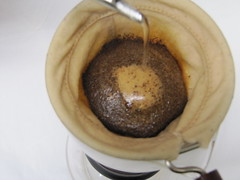
1 cup cloth woodneck

Monday, February 01, 2010

Some specs for the new water delivery system

Before there are knee jerk reactions and people start comparing the LB-1 to a boiler, it's not.
Here's what I know about it's specs:

- The LB-1 is 90% energy efficient because it is a system that only functions when in use.
- Temperature adjustment is instant: Can be changed via digital set point on display
- Current version has timer on display
- Plugs into household 110v outlet
- Takes a water input of a simple 1/4th inch john guest fitting.

- Directional point and shoot water dispersion from 'wand'.
- Adjustable flow rate.
- Largest flow rate seems to be around 8-9 ounces a minute. (It's designed for pour over so there doesn't seem to be a need to go any faster in testing it for pour over).

That's it, a water delivery system that plugs into a standard socket, hooks up to a standard inlet, and gives precision water temperatures and adjustable flow rate on demand. Oh, and the water comes out freshly heated, not stale and reboiled numerous times, so the coffee tastes better.

No cut up counters required to install, no electrician to wire a new plug, and no 200lb boiler. Just a table top, easy to move, and simple to install tap that is ready to go. Beautifully simple, just don't ask me how they did it. Something about PhD level engineering problems being solved and the patent is pending.

I won't try to project what the usefulness of this item is. I'll let the rest of you think about the implications of having freshly heated water from a movable and easy to use energy efficient hot water source.

Sunday, January 31, 2010

The difficulties of per cup

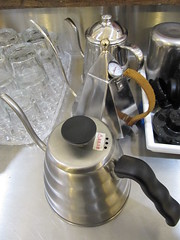
Articulated Water Delivery System: Simply put, the manual version of this concept is the hand pour kettle. Unlike a simple hot water boiling kettle, this version is designed with flow rate control in mind and the end user has an approximate but not precise control over the temperature. AWDS implies pouring where you want it at a flow rate you are trying to control. This is an important concept to think about when considering the usefulness and value of having control over flow. For the kettle though, this is an art form that takes an exceptionally long time to master. The difficult learning curve of balancing a kettle to get optimal flow presents a problem all it's own.

We can easily find other problems with nearly every option available for hot water delivery. They are inefficient, time consuming, and often impractical. So, let's take a moment to evaluate our options.

Table top boilers dispense water but you need to transfer that water to another container or bring the brew device to the water source. These boilers range from a large water tower down to a simple Zojirushi water boiler. These are always on and run continuously, tend to be very energy inefficient and the water is often stale.

Small hot water kettles are typically electric and boil water on demand. The main problems being that they need to have time to get up to boil and cannot handle any significant volume with speed. While fine for home use, they become increasingly impractical in cafe settings where any real volume is present.

The standalone brewer would be the so called 'per cup concept' that requires either a new brew method adoption or for the user to work with an entirely revised set of brew physics. The goal is often a tweaking of variables to attempt a quicker 'per cup.' This self contained brewer uses some new fancy way of brewing to set itself aside by trying to 'reinvent the wheel.' This kind of design concept is not only often expensive, it can easily have many flaws in design that may not show up until many users are out there testing it in real world scenarios well into sales and production. The real problem being that cup quality was often secondary to speed to balance the third item, cost.

So we acknowledge the problems and the question is, what's the solution?

We have an answer to that.
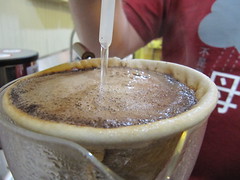
An AWDS that uses technology to provide flow controls and temperature controls would meet the need. It would not be a brewer by itself. Instead, it would provide hot water at precision controlled temperatures and adjustable flow rates through an articulated 'wand'. This would theoretically be the hot water delivery system that worked with all brew methods that could benefit from precision water temperatures and adjustable flow rate controls. All existing and widely used hand pour and general pour over methods would benefit from this system.
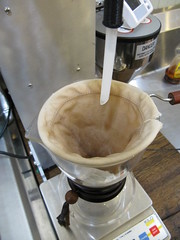
Instead of trying to create a new standalone brew system with new brew physics, a group of engineers have spent the last two years developing a hot water delivery system that functions as an AWDS. After an initial goal of stable temperatures and fixed flow rates, they have now tuned the device to respond to temperature and flow rate changes. That is unprecedented and as yet a largely unexplored avenue of brewing coffee outside of a few lab situations.

This would be an exteremly useful item for chemex lovers and melitta fans, but the real novel application seems to be when you tie in a product invented in 2006, the v60, it gets exciting. The v60 is designed in such a way that the flow rate of the water has an effect on the cup profile of the brew and adds another point of control. When used incorrectly or carelessly, it's a detriment to the resulting taste which creates a bit of a learning curve. The benefit of this control is that tied to a water delivery system with an articulated spout, dynamic temperature control, and adjustable flow rates, you have every variable in pour over brewing under control. Using technology to assist in brewing with an already familiar method speeds up the process to the point that brewing per cup now becomes very attainable in most cafe settings. Instead of reinventing the wheel, they came up with a design that works with all wheels making them more finely tuned and faster.
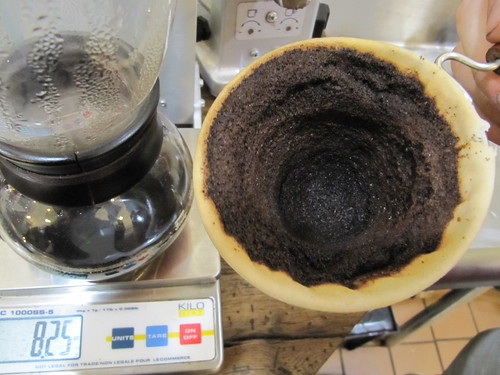
Resulting grinds from woodneck

Brilliant and yet simple in it's vision. I am lucky to continue to be a beta tester and have input on this project while this concept goes into production and heads towards market. Lex and I are code naming this 'The Hippocrene Project' but you can find out more in the next few weeks on the Luminaire Bravo 1 water delivery system via: http://luminairecoffee.com/