Featured Post

There and back again

My last few posts have covered a lot of ground on the early years and more recent events, but there's a messy middle. I could start this...

Wednesday, November 08, 2006

Espresso: Puckology


Interesting coffeed discussion.


Even though I agree with bits and pieces of what everybody posted (in the thread), I think Tim Wendelboe pretty much summed up my opinions on this matter. I believe there is more than meets the eye when you examine a spent puck. A soggy puck does not necesary equate to bad extraction, and in fact, sometimes what appeared to be pinholes are actually not a result of channeling. You have to spent a little time playing with different combinations of setups before you can really see what the puck is telling you.


Here's my take:


I believe how wet or dry the spent puck is largely a factor of the head space (result of the combination of group head design, basket size/depth, and dose volume) and how the 3 way valve is plumbed.


When there is little or no head space, the puck's expansion during depressurization is restricted, which results in a nice firm puck. With the type of coffee, flavor profile, and shot pulling style of most US shops, you will see mostly firm spent pucks. In this case, pinholes and fractures will definately tell you that something is wrong with the dose/distribution/extraction (though side channeling and intra-puck channels are much harder to detect...).


On the other hand, if the total expansion is less than or equal to the head space, then the spent puck will most likely to be spongy and sometimes, soggy wet. This is due to the puck's free expansion. Now, how the puck looks like (especially the top surface layer) is another story. My theory is that, it depends on how the 3-way is setup, you will either get a nicely shaped spongy puck or an ugly roughed-up mess.


With the coffees I use (light-roast, high acidity/intensity beans), I found that I get a better flavor profile if I don't up-dose and keep a nice head space. On the Linea/GB5/Synesso, this results in shapely but spongy spent pucks (with the GB5 having the best looking of 3). On the other hand, on my Rituale, the spent puck mostly looks like a ugly mess. The top layer are often very disrupted with "hills" pulled up by the depressurization (and subsequently stuck onto and broken by the group screen). Sometimes, you even see craters which, w/out careful examination, could be interpreted as pinholes. The ugly puck issue troubled me for quite sometime. It continued to puzzle me as I have checked with a naked PF numerous times and there were absolutely no channeling or other extraction issues (and the shots tasted perfectly fine). I recently had Jaime double check me and was reaffirmed that the ugly pucks are not indications of dosing/distribution problems.


My conclusion is that, due to the setup of the 3-way in my Rituale, the depressurization at the end of extraction is much more violent than the LM/Synesso setup. As a result, instead of letting the puck expand (relatively) gently, the puck (especially the top layer) was ripped up which caused all the roughness of the top surface layer. However, this has no effect on the shot as the phenomenon occured after the end of the extraction. So just like what Wendelboe said:


"But really, If the taste is excellent, what does it matter ?"


- Ben


ps. food for thought (tossing a bone here, dear readers): I know it prob adds to the complexity of the mechanical design, but why don't we see a group head design that has a separate path for depressurization (or maybe it already exists and I am just not aware of it but will be interested in knowing...). This way, all the residue will be (mostly) contained in the depressurization path, leaving the brew path relatively clean. Sure, you still have to clean it to prevent any sort of clogging, but I imagine this setup will produce a better cup in a busy cafe environment (where you do not have to luxury to detergent-flush the group often).

Monday, November 06, 2006

Tea: Judging Leaf Appearance


Photos by Ben Kaminsky


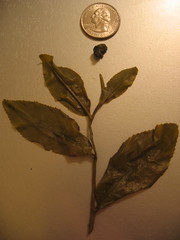
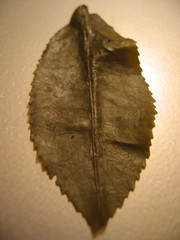
Left: a photo of a single unfurled leaf. Right: A quarter next to a rolled/unbrewed tea pearl with a brewed unfurled intact leaf/stem underneath.

Leaf appearance is a critical observation when judging the quality of a tea. Just like green coffee to a certain extent, you can judge the quality and the degree of precision in processing just by looking at the leaf. In China and Taiwan, the teas are sometimes named after their dried leaf appearance. In many cases, the leaf appearance cannot tell you exactly what kind of flavor it has, but it can certainly tell you all about the processing, and from knowledge of the processing you should be able to tell where the flavor is coming from. According to the Tea Research and Extension station in Yangmei Taiwan, “As a matter of fact, it is a good quality tea, as long as it looks good.” The idea behind this theory is that the people who are judging the tea train themselves to detect flaws in appearance that parallel those in taste.
When judging a tea by leaf appearance, one must look for several things. In the dry leaf, consistency, degree of oxidation, and roast or firing is evident. Also the skill with which the tea was handled and sorted is evident by the shape and consistency in size. The post steeped leaf can tell you how consistant the grading was and reveal flaws in the oxidation.

For example, things I look for in a Semi-ball type Poachong tea (the tea in the photo) are consistency in size, shape and color. The color tells you how heavy the oxidation and roast are. Size and shape tell you how well sorted the tea was, and also how the leaves were manipulated in the processing. In the wet leaf(after it is steeped), I look for evenness of oxidation, color, and how intact the leaf structure remains. A good semi-ball paochong should have very few broken particles when brewed and for the most part, the leaves should stay intact through the duration of the steepings. If the oolong leaf shows too much brown, this is a sign of too much oxidation and is contributing to the bitterness and astringency of the tea.
Judging what a tea should look like is different with each tea, and should be judged according to what the tea manufacturer was trying to get. In the end, cupping a tea's taste is the deciding factor, but leaf appearance helps explain how and why the tea tastes a certain way.


-Silas


Also see:

Tea: Processing

Cupping high grade taiwanese teas

Say it ain't so~ (Intelligentsia)

Was browsing thru my latest Crate and Barrel catalog and found this:

"Well Street Blend"


How could Intelligentsia insure any sort of freshness/quality control of these products? Or are we seeing the beginning of "Starbucks-fication"?

- Ben

Monday, October 30, 2006

Coffee is a fruit?


Coffee is a fruit not a bean. I used to say that a lot to really make people understand that you can't be afraid of the fruit. The fruit can be very delicious. A coffee that is very jammy and sweet is not your milk and sugar coffee but it is more like a sweet red wine.


I personally love the great clean perfume Yirgs. The great antithesis to the funky fermenty Harrars.
A thought, the absence of roast flavors is the essence of coffee flavors. I have this theory that the absence of roast bitters allows you to taste more of the sweetness in these dense uber coffees. Bitter confuses the palate and hides the sweetness. While I admit you can manipulate some really interesting roast flavors at times(especially in espresso), the fruit is what is unique.
It comes back to what George talks about with the coffee horizon. A concept where coffees are a commodity where all the micro lots are blended together and roasted/processed as such into one generic coffee profile. When you roast dark and slow enough, you can make most any coffee into a dull cocoa with a generic coffee flavor. He's right about that. The thing is it also applies to espresso and over blending. When we put filler in the blends that may cover or hide much of the interesting tastes in the coffee.
We should seperate the coffees at harvest into smaller and smaller lots to help isolate the most complex and unique lots. Goerge is pioneering this and the CoE helps a lot.
With all that said, I'm going to take some time and learn more about tea. I am tired of bickering with people who just focus on renaming the standards instead of finding a better cup. Minutia over flavor. When it comes back to flavor, I'll be there.
Does anyone get the feeling that the Scandanavians in general and especially the Danes are drinking better espresso than us on a daily basis? While we are wowing over 2oz doubles of lightly roasted Yirg SoE, that may be old hat for them! Something to ask the last three WBC champs.
-Jaime

Saturday, October 28, 2006

Cupping high grade taiwanese teas.


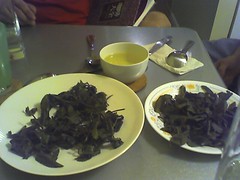
Checking the leaves after the cupping which were very intact, undamaged and pretty. Thy expanded with each brew until being fully unfurled.

Dha yu ling and a Pear mountain tea from taiwan. Each taiwanese tea was high grown and sells for $100 per 5.5oz. These teas were both at the base very sweet and intensely floral.
Fresh crop!
Flavor cuppa notes:
Pear mountain - pear, cinnamon, mint, honey, super creamy, and lemon drop aftertaste.
Dha yu ling - molasses, cinnamon graham cracker, clean cucumber, grape soda aftertaste.
Summary: We don't drink teas like this in the states! Silas needs more of these!
The sweet aftertastes linger in a super sweet clean flavor for many minutes afterwards.
-jaime


UPDATE: I realized that after this cupping we had to rethink everything one more time. If the tea industry is this advanced in Taiwan, then it means this is where the coffee industry should be or will be going. It's scary to think but maybe that's what it's about. The tea's were expressive, amazing, and complex. They were worth getting excited about. They were more complex than any tea I have had. Granted I have visited china and Japan but these blew down any of those expereiences by a long shot. It was strange how you could taste layers of flavors in the cups. Tea has this potential? That's something to think about.

Big cheers to Ben's dad in Taiwan for arranging them!