Featured Post

There and back again

My last few posts have covered a lot of ground on the early years and more recent events, but there's a messy middle. I could start this...

Thursday, October 26, 2006

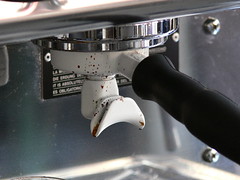
Teflon Portafilters


Originally uploaded by Chris Owenscoffeemutiny.

I love this idea of having teflon portafilters on a bar. I don't know why everyone is so cool to the idea here in the US. It seems fabulous to just be able to rinse and wipe the portafilter and not worry about rancid oil buildup.

Jaime

Diagnosis of a label

On our last trip to New York, I came across a few bits and pieces in one of the McDonald's gas station combo rest areas you see in CT on I95. Inside is a McDonalds and a coffee stand selling Lavazza. At the stand was this big board describing PB&J lattes and Nutty Buddy lattes as 'Specialty Coffee.' Those drinks had little to do with coffee but the irony was that right across from the stand was a huge sign for McDonalds iced coffee as a 'Premium Roast.' I thought, all we need is a Starbucks in the building! Then we could round out with some 'gourmet coffee' or some other nondescript term the marketers came up with. I chuckled a bit but it was kind of sad. With those terms, it's just varying derees of the same spin.

The coffee industry is running out of nondescript terms to describe it's coffee.
There, I've said it. When Starbucks says "This coffee is bold." I'm sorry, I looked it up and I still don't know what it means in terms of coffee! How about robust? I still struggle with full bodied. Now if my coffee is not Bold, Robust, and Full-bodied, it must be meek, weak, and light??? It's marketing spin isn't it? They must assume by controlling the label to make it sound nice without really saying anything they have succeeded in delivering the product with ambiguous terms that cannot be identified as positive or negative. It takes a lot more guts to describe the flavors in a coffee than to just say it's "full bodied and smooth." Check the coffee boards of some of these corporate shops and try to really pin down exactly what they are saying. It's all very nondescript and vague. Try the Starbucks site, that's my favorite. Just scroll through and imagine trying to tell a friend what each of the -flavor- descriptors of each of the coffees means. This one has zest! This one is bold! Say what? Then again maybe that's better than saying bitter, ashy, and burnt!

It seems that the marketing just muddies the proverbial water. Diluting and confusing the facts until the consumer gets into a routine of "Venti Breakfast blend." That's the real danger when someone is convinced that they know what that means and are so comfortable ordering it, they cannot go into another shop and order something else without confusion. The marketing gets into your routine and you have been pushed to recite the branding terms until you forget that you have been branded. Now, when you go into another shop, you must unlearn your routine and go back to normal land where there are small, med or large. OR Where a cappuccino may actually be a true italian 6oz microfoamed cappuccino and not large foamy latte.

Sadly, I really don't see it stopping anytime soon but we should not give up and roll over.
So, How do we fight this:

Transparency

Consumer Education

Perceivable Quality(and value)differences

Online Forums and other free information sources

Exceptional product in the independent Cafe


All opinons welcome-

Jaime

Tuesday, October 24, 2006

Costa Rica: Reflecting on water

Last winter when I was travelling through central america, I volunteered at a coffee farm for about a week and a half. Now the water quality in most of central america (Belize, Guatemala, El Salvador, Hondorus, Nicaragua and Panama) is fairly poor, but Costa Rica because of the economic situation in most of the country, is an exception for the most part. So after having to buy filtered water or purifying my water with iodine tablets for 2 months, I was surprised to find that the coffee farm had clean, fresh tasting water. It came from springs near by and collected in a well underneath the guest house. For several days the other guests and I were drinking the water with delight, relived that iodine was not necessary. After maybe 5 days I noticed a soapy taste in the water and started to get concerned that maybe the water wasn't as good as I had thought earlier. The other volunteers didn't notice any thing strange about the taste so I kept drinking it, thinking that maybe they had a chlorinated source. After washing some dishes one night I realized there was a hole in the sink. I ran the faucet and went outside to see a good amount of water dripping into the ground right below the sink. The pipe that brought us fresh water was right there sticking in the ground and it turns out that the soapy dish water was leaking into our well beneath the house. I patched up the hole as best I could and put a pot underneath the sink to catch the excess water leaking through. After about a day or so, water started to taste alot cleaner and like it did the first couple of days I was there. I never thought developing my palate would actually be practical like that!


Now several months later after coming back from california, I am realizing how incredibly critical water quality and chemical make up is for tea. I think my brita has a learning disability, cuz the water goes through it too fast. I tried poland spring and volvic and neither work as nicely as the water in cali. Ben's filtered and softer water worked fairly well, but I still can't get that same sweet and fullness as in california. Whatever ends up working, I realized that where ever you are in the country your water is probably gonna be a little different. I know that when I was in Arizona several years ago, the water tasted aweful cuz it had been sitting in the pipes for a really long time. Maybe I just need to get a new filter...


-Silas

Monday, October 23, 2006

Trials and tribulations of a mouthwatering cupper.

I think we love the taste. The sensations, the flavors, the colors that it inspires in the imagination. Drink fine red wines, uber whiskeys/bourbons, rice wine, grappa, you name it... oh yeah and teas too. The flavor is what gets us so excited. Finding those unique flavors and then sharing it. That's what I love about a good barista. Finding that one extraction of the espresso where the temp, the timing, dose, all come together to reveal for that coffee the roasted peanuts with a buttery viscosity leading one to declare 'peanut butter!' A eureka moment really. What if every new coffee is a eureka moment and playing with each extraction leads to new and distinct tastes that really excite you because you know even the average untrained palate can see the difference between the light sweet floral Yirg and the peanut butter chocolate cup espresso presented before them.

Sadly this just isn't the case. When I play around with George's coffee's, I get that. When I get a special batch from Andrew to muck up, I get that. It just doesn't happen very often besides one time experiences outside of those two roasters.

So when you read our enthusiasm, we aren't really crazy... well not too much. You have to be in the same room or have an experience like we have had... a shared experience and then it all clicks. Sometime you really have to be in the same room to get it and relate.

In George's roasts it's like lifting a veil off the coffees and exposing them clearly. George is the exception with his light roast style though. It took me a while to get it but I do and I'm better for it.

The end result is I have now priced myself out of most of the things I could enjoy if I didn't focus so much on flavor. When you cup, you think more about flavor. In the end, you train yourself to become more discriminating about what you eat or imbibe and then your bank account will suffer!


-Jaime

Saturday, October 21, 2006

San Francisco Tea summary

I got back a few days ago, and I am still starry eyed from Bay Area’s essence. The Tea culture and the whole gourmet culture in general seems to be living proof that flavor can exist in a true and accessible fashion. A friend told me that there are about 100 bakeries in the city for San Francisco alone. There are some wonderful food experiences to be had in the area, as Andrew showed us. There are many tea houses of various quality and feel. A few of the more well known ones are Imperial Tea Court, Far Leaves and Samovar. To the best of my knowledge Imperial Tea Court and Far Leaves both source tea directly from estates in China. Another well know tea house is the Celadon Tea Room. They are renowned for their quality and freshness. Unfortunately, I missed my chance to go there because they are currently switching locations.


The Tea Culture in the San Francisco Bay Area is one that is entirely its own. Tea is much more a part of daily life and culinary experience than it is in Boston. This is obviously because of the strong Chinese and Japanese influence. Seeing Tea Houses ranging from good to simple doing well gives me hope for what Tea in the United States could become. As the culinary culture and focus on quality in what we eat and drink continues to grow, it is nice to see a few people paying attention to Tea. I only hope that this culture will continue to grow and the quality will improve. I hope also to see more focus on the flavor of tea as opposed to the conscious altering effects and social aspect of tea.


Lots of inspiration to keep tasting, and a desire to figure out what they put in their water was found in California.


-Silas